

By Nested Exotics Team | Last updated: August 2026
Quick answer: Reptile-friendly apartments in Phoenix can be harder to find than conventional pet-friendly rentals, but they do exist. Common pet reptiles such as ball pythons, corn snakes, bearded dragons, and leopard geckos can generally be possessed in Arizona without a special AZGFD license when the species isn’t classified as restricted wildlife and the animal was lawfully acquired and possessed under applicable Arizona rules. But keeping one in a Phoenix apartment is a separate question: the property’s own lease and pet policy must also permit it.
As of August 2026, we’ve verified two Phoenix apartment communities with published policies that explicitly name reptiles — Renaissance Apartment Homes and Ironwood at Happy Valley. Phoenix’s City Code § 8-6 separately addresses registration of “poisonous reptiles.”
This guide is part of our complete framework for renting with exotic pets, applied here specifically to Phoenix — if you’re comparing cities, see our Austin and Denver reptile rental guides as well.
| At a glance | Answer |
|---|---|
| Common pet reptiles covered by this guide (ball python, corn snake, bearded dragon, leopard gecko) generally lawful to possess? | Generally yes, when the species is not restricted and the animal was lawfully possessed and acquired in accordance with applicable Arizona rules |
| Special AZGFD license generally required for those non-restricted species? | No — assuming the species is not restricted and the animal was lawfully possessed and acquired in accordance with applicable Arizona rules |
| Phoenix registration for ordinary non-venomous reptiles? | No specific registration requirement identified under § 8-6 |
| Phoenix registration for “poisonous reptiles”? | Yes — under City Code § 8-6 |
| Phoenix apartment communities whose published policies explicitly name reptiles | 2 |
| Published charges at the two confirmed properties | $300–$400 upfront per pet; monthly pet rent starts at $30/pet, with Renaissance at $60/month for two pets and Ironwood at $35/month per pet |
| Guide last verified | August 2026 |
Important: Arizona law determines whether you may legally possess a particular reptile; it does not require any private apartment community to accept that animal. A rental property’s written lease and pet policy can impose additional restrictions beyond what state or city law requires.
A property-level reptile-friendly policy doesn’t automatically guarantee approval for every species, enclosure, or lease — individual unit, occupancy, or manager-approval conditions can still apply. Always confirm at the individual-application stage.
Scope: This guide covers commonly kept, captive-bred reptiles — ball pythons, corn snakes, bearded dragons, leopard geckos, and similar pet-store species. Venomous species, large constrictors, native or wild-caught animals, and anything on Arizona’s restricted-wildlife list are governed by additional rules not covered here.
Legal-information note: This guide is informational, not legal advice. Ownership rules can change and can depend on the exact species and circumstances. Verify anything unusual directly with the Arizona Game and Fish Department (AZGFD) and the City of Phoenix.
In This Article
How We Verify a Phoenix Property as Reptile-Friendly
We’re stating this up front, before the property list, because it’s the standard that determines everything else in this guide.
We do not treat a property’s general “pet-friendly” label — or even a broader “exotic pets welcome” claim — as evidence that reptiles specifically are permitted. A property is only listed here under one of these ratings:

| Rating | What it means |
|---|---|
| Confirmed — Written Policy | The property’s current published pet policy explicitly names reptiles as permitted. Strongest evidence tier — anyone can check the source. |
| Confirmed — Written Leasing Confirmation | The published policy doesn’t explicitly address reptiles, but the leasing office has confirmed in writing (email, addendum) that they’re permitted. Real evidence, one step below a public policy. |
| Policy Conflict | Two or more current property-controlled sources make materially contradictory statements about reptile permission — for example, one page explicitly permits reptiles while another explicitly prohibits them. |
| Prohibited | A current property-controlled source explicitly excludes reptiles, and no equally authoritative current source expressly permits them. |
| Policy Unclear | The property addresses pets or “exotics” generally but doesn’t mention reptiles either way. |
| Not Verified | We don’t have reliable current evidence. A generic “pet friendly” marketing page alone doesn’t qualify. |
Every Confirmed property carries a verification date. As of this update, we have two Confirmed properties in the Phoenix area — not a comprehensive directory, but two properties with real, checkable, written evidence behind them. We’d rather show you two verified properties than thirty scraped ones with no way to confirm reptiles are actually included.
At a glance — the two properties we’ve confirmed:
| Property | Status | Reptiles named? | Charges | Last verified |
|---|---|---|---|---|
| Renaissance Apartment Homes | Confirmed — Written Policy | Yes | $400/pet upfront + $30–$60/mo | August 2026 |
| Ironwood at Happy Valley | Confirmed — Written Policy | Yes | $300/pet + $35/mo | August 2026 |
Full evidence, addresses, and the exact policy language for each property are below, along with a look at a property that explicitly excludes reptiles — a useful contrast for calibrating what “reptile-friendly” marketing actually means.
What Arizona Law Actually Regulates
Arizona’s default rule is that no person may import, transport, or possess live “wildlife” without authorization — but an exception covers most pet owners: a person may possess reptiles not classified as restricted wildlife, without a special AZGFD license, provided the animal was lawfully acquired and possessed under applicable Arizona rules. Ball pythons, corn snakes, bearded dragons, and leopard geckos are common pet-trade species, and our review of the current rule indicates they do not fall within Arizona’s restricted reptile categories. <details> <summary><strong>For readers who want the legal detail</strong> (click to expand)</summary>
Arizona’s default rule, set out in Arizona Revised Statutes §17-306 (official Arizona Legislature text), is that no person may import, transport, or possess live “wildlife” in the state except as authorized by the Arizona Game and Fish Commission. Under the statute’s own definitions (ARS §17-101), “wildlife” is written broadly enough to include reptiles.
Arizona Administrative Code R12-4-405, part of the official Title 12 compilation maintained by the Arizona Secretary of State, states that a person may possess mammals, birds, amphibians, and reptiles not listed as restricted wildlife under R12-4-406, without a special license — provided the animal was lawfully acquired.
R12-4-406, in that same official compilation, is the restricted list itself. Under R12-4-406(A), to lawfully possess a species on that list, a person must hold all applicable federal licenses and permits plus the appropriate AZGFD special license, or act under a specific statutory exemption. R12-4-406(B) states that the Commission recognizes ITIS’s online taxonomic classification as the authority for determining these restricted-wildlife designations. The rule’s restricted-reptile provisions name specific categories — for example, all species of the order Crocodilia, and several snake families including Atractaspididae and Elapidae — rather than attempting to list every individual species by common name.
Arizona’s Article 4 live-wildlife rules were amended in 2026; AZGFD announced the amended rules as in effect on February 26, 2026, and the updated rule text is reflected in the current Arizona Administrative Code cited above. A secondary report on AZGFD’s amendment announcement — cited here only for the 2026 amendment history, not for the underlying legal conclusions above — describes the changes to R12-4-406 as additions of specific aquatic-wildlife taxa and a clarification of the Northern Bobwhite quail restriction. Because these rules can change, renters with unusual species should check AZGFD’s current materials directly rather than relying on an older species list. </details>
What this means for a typical reptile owner: Our review of the current rule and its taxonomic framework indicates that ball pythons, corn snakes, bearded dragons, and leopard geckos do not fall within R12-4-406’s restricted reptile categories.
| Common name | Scientific name | General pet category |
|---|---|---|
| Ball python | Python regius | Non-venomous pet snake |
| Corn snake | Pantherophis guttatus | Non-venomous pet snake |
| Bearded dragon | Pogona vitticeps | Pet lizard |
| Leopard gecko | Eublepharis macularius | Pet lizard |
For regulatory purposes under R12-4-406, an animal’s taxonomic identity matters more than its common pet-trade name — the rule operates by taxonomic category and incorporates ITIS classifications, rather than listing every species by common name. This is an informational reading of the current rule, not an individual species determination by AZGFD. Owners of unusual species, hybrids, or animals with uncertain taxonomic lineage should verify the exact animal directly with AZGFD, since a name’s absence from any secondary summary — including this one — isn’t the same as an official confirmation from the agency that administers the list.
General information, not legal advice.
Phoenix-Specific Rules to Know
Legal information last verified: August 2026.
Phoenix City Code § 8-6, “Reptiles or wild animals,” states: no person shall keep or maintain any poisonous reptiles or dangerous carnivorous wild animals without first registering them with the Director of the Phoenix Police Department, who may set rules for safe caging. Phoenix’s ordinance uses the term “poisonous reptiles.” In this guide, we use “venomous” as the more familiar biological term, but when determining whether a species is covered, rely on the ordinance’s actual wording.
The section specifically addresses “poisonous reptiles” and dangerous carnivorous wild animals; it does not state that ordinary non-poisonous pet reptiles must be registered. Because ball pythons and bearded dragons are non-venomous, they do not appear to fall within § 8-6’s “poisonous reptiles” registration provision.
Beyond that section, Chapter 8 of the Phoenix code contains general animal-keeping provisions — for example, § 8-5 prohibits keeping any animal in a way that disturbs neighbors’ peace or health. We haven’t independently confirmed that every general provision in Chapter 8 explicitly applies to reptiles the same way it applies to conventional pets, so we’d stop short of promising that. Other general animal-keeping provisions elsewhere in Chapter 8 may also apply depending on the circumstances; Phoenix’s municipal code is published in full at phoenix.municipal.codes and is worth checking directly for your situation.
What this means for a typical reptile owner: § 8-6 itself doesn’t add any registration requirement if you keep a common non-venomous species. If you keep a reptile covered by § 8-6’s “poisonous reptiles” provision, registration with the Phoenix Police Department is required; confirm the current registration process directly with the department. Other general animal-keeping provisions elsewhere in Chapter 8 may still apply to any pet, reptile or otherwise.
General information, not legal advice.
A note on “Phoenix” vs. “Phoenix metro”: This section applies to properties physically inside Phoenix city limits. Scottsdale, Tempe, Glendale, Mesa, Chandler, and Peoria all have their own municipal codes, which may differ. Don’t assume a property with a “Phoenix, AZ” mailing address is necessarily inside the city — some Phoenix-metro apartment communities sit in unincorporated Maricopa County or in a neighboring city. This distinction matters for the properties below: both of our confirmed listings are physically inside Phoenix city limits, which we verify individually rather than assume from a mailing address.
Apartments That Allow Reptiles in Phoenix
Verification snapshot — August 2026
- Phoenix properties with published reptile permission verified: 2
- Properties with an explicit published exclusion: 1
- Phoenix city code checked: § 8-6
- Arizona restricted-wildlife rules checked: R12-4-405 / R12-4-406
As of this August 2026 verification, we identified two Phoenix apartment communities whose current published pet-policy pages explicitly name reptiles among permitted exotic pets — “Exotic Pets/Animals: Including Reptiles (snakes, iguanas, etc.), Ferrets, Skunks, Raccoons, Squirrels, Rabbits, Birds.”
These are the two reptile-friendly apartments in Phoenix we’ve been able to verify through current, published property-controlled policies.
Renaissance Apartment Homes
| Status | Confirmed — Written Policy |
| Evidence | Published pet policy, missionrockresidential.com |
| Reptiles named | Yes (“snakes, iguanas, etc.”) |
| Pet charges | $400 upfront per pet ($200 refundable deposit + $200 non-refundable pet fee); $30/month pet rent for one pet, $60/month for two pets |
| Address | 13421 N 43rd Ave, Phoenix, AZ 85029 (North Mountain area) — within Phoenix city limits |
| Policy verified | August 2026 |
Ironwood at Happy Valley
| Status | Confirmed — Written Policy |
| Evidence | Published pet policy, missionrockresidential.com |
| Reptiles named | Yes (“snakes, iguanas, etc.”) |
| Pet fee | $300 per pet |
| Monthly pet rent | $35 per pet |
| Address | 24025 N 23rd Ave, Phoenix, AZ 85085 (Deer Valley area) — within Phoenix city limits |
| Policy verified | August 2026 |
Under our evidence-strength distinction: both properties above are Confirmed — Written Policy (the property’s own published policy names reptiles). A property whose written policy is silent on reptiles, but whose leasing staff confirms it by email or in writing, would instead be logged as Confirmed — Written Leasing Confirmation — real evidence, but one step down from a public, published policy anyone can check.
Properties We Reviewed
| Property | Status | Reptiles specifically named? | Evidence | Last verified |
|---|---|---|---|---|
| Renaissance Apartment Homes | Confirmed — Written Policy | Yes | Published pet policy | August 2026 |
| Ironwood at Happy Valley | Confirmed — Written Policy | Yes | Published pet policy | August 2026 |
| Broadstone Desert Sky | Prohibited — except turtles | Yes — prohibited except turtles | Published FAQ page | August 2026 |
This table will grow as we verify more properties — see below for the Broadstone case in detail.
Broadstone Desert Sky — Prohibited, except turtles. Its current FAQ page expressly states that exotic animals, reptiles, rodents, insects, and amphibians are not permitted, with an exception for turtles. Its separate pet-policy page identifies caged exotic birds as permitted but doesn’t mention reptiles. Because the current published materials don’t expressly permit reptiles, and the FAQ expressly prohibits them, we classify the property as Prohibited (except turtles). It’s a useful contrast to Renaissance and Ironwood precisely because a property advertising some exotic-pet flexibility (“Exotic Birds”) can still exclude reptiles specifically — always check for the word “reptile,” not just “exotic.” Policy verified: August 2026.
We’re tracking reader-submitted experiences with other Phoenix properties. If you’ve successfully rented with a reptile somewhere in the area, let us know through our main exotic pet rental guide, and we’ll work toward expanding this into a fuller directory over time.
“Pet Friendly” and “Exotic Pets Welcome” Don’t Automatically Mean Reptile-Friendly
A property’s general pet-friendly marketing — even language as specific as “exotic pets welcome” — doesn’t guarantee reptiles are included, as the Broadstone Desert Sky example shows. Ask the leasing office directly whether reptiles specifically are permitted under the written policy, and get the answer in writing if you can.
One related but separate issue: an ordinary pet reptile is legally different from a disability-related assistance or emotional support animal. Those fall under separate federal, state, and local disability-accommodation law with their own process. This guide covers ordinary pet ownership only — if an assistance-animal accommodation applies to your situation, it’s worth handling as its own conversation with a qualified source rather than assuming this guidance carries over.
Deposits and Fees: What to Expect
Among the two properties currently confirmed in this guide, published upfront pet charges range from $300–$400 per pet; monthly pet rent starts at $30/pet, with Renaissance publishing $60/month for two pets and Ironwood publishing $35/month per pet. The published policies list these charges alongside their broader pet and exotic-animal rules — prospective renters should confirm with the leasing office exactly which charges apply to their particular reptile. That’s a reasonable starting expectation, not a market-wide guarantee — it’s built from two properties, not a survey.
Before You Apply: The Right Order of Questions
- Identify your species precisely (common and scientific name) — regulatory treatment can hinge on the exact species.
- Check Arizona’s state-level rules for that species (above).
- Check Phoenix’s city-level rules — mainly relevant only if your species is venomous (above).
- Read the specific property’s written pet policy before touring. Look for the word “reptile” specifically, not just “exotic pets” or “pet friendly.”
- If the policy doesn’t address reptiles either way, contact the leasing office directly.
- Get written confirmation — an email or lease addendum, not a verbal yes.
- Review the actual lease and pet addendum before signing. That document governs your tenancy, not the marketing page or a verbal assurance.
- Document your enclosure and confirm your insurance situation (see below) before move-in.
Phoenix Heat: Two Different Problems for Reptile Keepers
Phoenix’s extreme heat creates two separate practical problems for reptile keepers, beyond normal enclosure setup — and neither one is solved simply by the fact that many popular pet reptiles come from warm climates. Species vary widely in their native conditions, and each still needs its own controlled enclosure temperature, humidity, and lighting regardless of what’s happening outside.
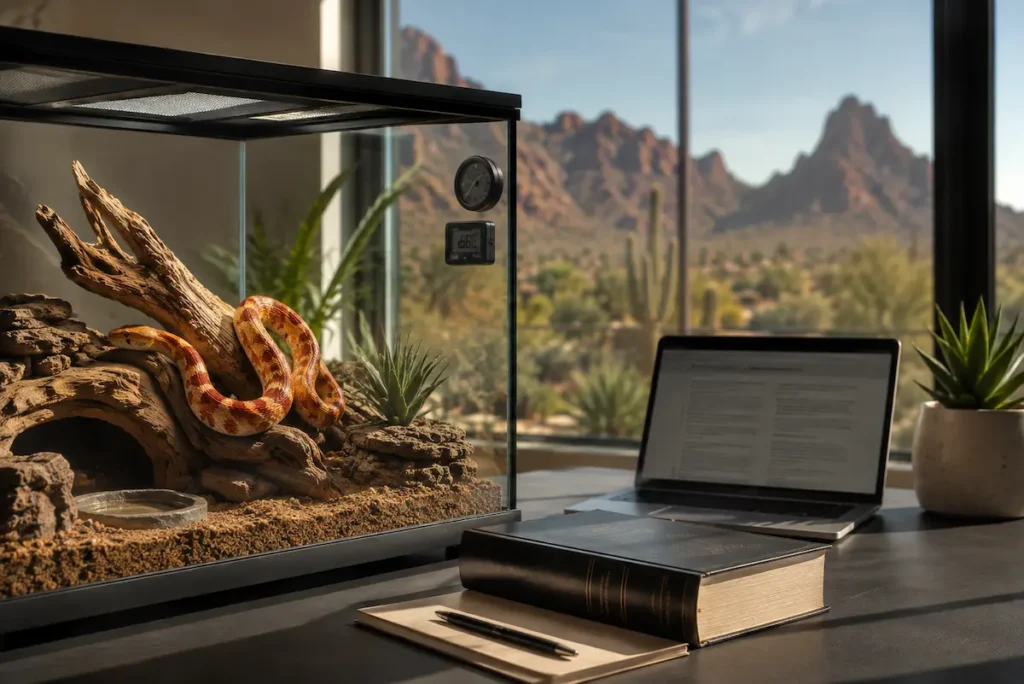
Enclosure placement and overheating. A glass enclosure in direct desert-facing window sun can overheat rapidly — a genuine animal-welfare concern, and one that has nothing to do with what a landlord cares about. Keep enclosures away from direct window exposure regardless of what your lease says.
HVAC and power reliability. The less-discussed issue: what happens if your unit’s air conditioning fails, or the building loses power, during a prolonged period of extreme summer heat. For most reptile owners the challenge isn’t heating the enclosure — it’s ambient room temperature if climate control goes down for hours. Keep a backup thermometer/hygrometer in the enclosure, have a plan for where to move the animal short-term if an outage looks extended, and know your building’s maintenance-request process for HVAC outages before you need it.
A secure, well-maintained enclosure can also address practical landlord concerns such as escape prevention and sanitation, but the property’s own rules still control. Building weight capacities for a large, fully set-up glass terrarium (substrate, water, decor) vary by property and floor; ask the property manager directly if you’re planning a large tank or several enclosures, rather than assuming either way.
How to Ask a Phoenix Landlord About Your Reptile
Copy-and-paste message to a leasing office
“I wanted to let you know I have a pet [ball python / bearded dragon / leopard gecko]. My reptile lives full-time in a secure, [size]-gallon enclosure that stays in one location, and the enclosure is designed specifically to prevent escape. I’m happy to provide photos of the setup and any documentation the property requires, and I’m glad to comply with the property’s pet terms, sign a pet addendum, and pay any applicable deposit or fee.”
This addresses the three things a leasing team is actually likely to be uncertain about — containment, what the setup involves, and the financial terms — without asking them to improvise an unfamiliar fee structure on the spot. Because Renaissance and Ironwood already address reptiles explicitly in their published policies, prospective renters have concrete examples of the type of written language they should look for when evaluating other Phoenix properties.
Rental Application Checklist
- Confirmed your specific species is permitted (Arizona state and Phoenix city level)
- Confirmed with the leasing office that “pet friendly” or “exotic pets welcome” includes reptiles specifically
- Got reptile approval in writing, ideally as a signed lease addendum
- Confirmed whether a pet deposit or monthly pet rent applies, and whether it’s refundable
- Checked the lease for species-specific exclusion language
- Asked about enclosure-size or weight guidance, if planning a large tank
- Asked your renters-insurance provider what coverage, exclusions, and liability/property-damage provisions apply to your specific reptile and enclosure
- Confirmed whether multiple reptiles are permitted, if relevant
- Photographed your enclosure setup before move-in, for your own records
- Kept any permit documentation accessible, if your species requires it
- Created a backup plan for maintaining appropriate enclosure temperatures during an HVAC or power outage
Local Resources for Phoenix-Area Reptile Owners
| Resource | Area | Useful for |
|---|---|---|
| Phoenix Herpetological Sanctuary | Northern Scottsdale (metro, not Phoenix city) | Education, surrender, rehabilitation |
| Arizona Exotic Animal Hospital — Phoenix office | 2340 E Beardsley Rd, Phoenix, AZ 85024 · (623) 243-5200 | Exotic and reptile veterinary care |
Phoenix Herpetological Sanctuary — a nonprofit reptile sanctuary in northern Scottsdale (registered as a 501(c)(3)), not within Phoenix city limits, so treat it as a metro-area resource rather than a Phoenix one specifically. Offers education programs, rehabilitation, and surrender services for reptile owners. The organization’s own site describes it as the largest reptile sanctuary in the United States.
Exotic-specialized veterinary care — Arizona Exotic Animal Hospital operates a Phoenix office providing exotic-animal and reptile veterinary care, alongside Mesa and Tucson locations. If a specific veterinarian’s board certification (for example, through the American Board of Veterinary Practitioners) matters to your decision, confirm current credentials directly with the practice or the certifying board rather than relying on a promotional bio — these details change as staff join or leave a practice.
Frequently Asked Questions
Do I need a permit to own a pet snake in Phoenix?
For a common pet-trade snake that is not classified as restricted wildlife under R12-4-406 and was lawfully acquired, Arizona’s current rules generally do not require a special AZGFD license solely to possess it. Phoenix’s city code separately requires registration only for reptiles covered by § 8-6’s “poisonous reptiles” provision, not ordinary pet snakes.
Are ball pythons legal to possess in Phoenix?
Based on our review, ball pythons aren’t among R12-4-406’s restricted reptile categories. Because they’re non-venomous, they also do not appear to fall within § 8-6’s “poisonous reptiles” registration provision. As always, confirm the property’s own lease terms separately.
Are bearded dragons legal to possess in Phoenix?
Based on our review of Arizona’s current restricted-wildlife rules, bearded dragons (Pogona vitticeps) do not appear to fall within the restricted reptile categories requiring an AZGFD special license. Phoenix’s § 8-6 registration provision separately addresses “poisonous reptiles” and doesn’t appear to cover them. Property-level lease restrictions still apply — confirm separately.
What about other common non-venomous pet snakes generally?
Generally yes, assuming the species isn’t restricted under R12-4-406 and was lawfully acquired/possessed. Species-specific verification still matters — “snake” isn’t a legal category, “restricted” or “not restricted” is.
Which Phoenix apartments actually allow reptiles?
We’ve confirmed two reptile-friendly apartments in Phoenix with published policies explicitly naming reptiles: Renaissance Apartment Homes and Ironwood at Happy Valley (details above). This isn’t a comprehensive list — policies change, and this reflects what we’ve verified so far, not every reptile-friendly property in the metro. If you’re comparing Phoenix with another U.S. rental market, our reptile-friendly apartments in Denver guide uses the same evidence-focused approach.
Can a landlord charge pet rent for a reptile in Arizona?
Pet fees and pet rent are generally matters of the lease itself and applicable Arizona landlord-tenant rules. The amount, whether any deposit is refundable, and whether reptile-specific charges apply should be confirmed in the written lease before signing — don’t assume terms based on what a property charges for dogs or cats. The two confirmed properties publish pet fee structures that also apply within their broader pet/exotic-animal policies, but that’s a property-specific structure, not a rule you can count on elsewhere.
Can apartments legally ban reptiles even if they allow dogs and cats?
Yes — a property can prohibit specific animal types in its lease or pet policy even when the animal is legal to own generally. Legal ownership and contractual permission to keep an animal in a specific rental are two separate questions. See our main exotic pet rental guide for more on this distinction.
What Phoenix-area suburbs have reptile-friendly apartments?
We don’t yet have verified properties outside Phoenix city limits to report — Scottsdale, Tempe, Glendale, Mesa, Chandler, and Peoria are all worth checking directly, and each has its own municipal animal code that may differ from Phoenix’s. We’ll expand this guide as we verify metro-area properties.
Should I disclose my reptile before applying, or after being approved?
Before applying, or at latest during the application. Disclosing upfront builds trust with a landlord; being discovered later — even with a completely harmless pet — damages that trust in a way that’s hard to repair.
Is Phoenix a good city for reptile owners?
Arizona’s state framework generally permits possession of many common non-restricted pet species, while Phoenix § 8-6 specifically addresses “poisonous reptiles.” We also found genuine published examples of Phoenix properties that explicitly name reptiles in their pet policies. Your individual species and specific lease still need to be checked, but the starting position here is evidence-backed rather than a guess.
How We Keep This Guide Current
Apartment pet policies and legal citations both change. Our maintenance approach:
- Every property listed as Confirmed is re-checked against its current published policy on a rolling basis, targeting roughly every 90–180 days, with the verification date updated accordingly.
- Legal citations (ARS §17-306, AAC R12-4-405/406, Phoenix City Code §8-6) are checked against the current official text at each update, rather than carried forward from a prior version of this guide.
- If a property’s policy changes in either direction, we update its status rather than leaving a stale “Confirmed” rating in place.
Have information about another Phoenix-area building, or a species not covered here? Reach out — it helps us decide which properties and cities to verify next.
2 thoughts on “Reptile-Friendly Apartments in Phoenix, AZ: A Renter’s Guide (2026)”