
By Nested Exotics Team | Last updated: August 2026
Yes, you can find reptile friendly apartments in Austin — but “pet-friendly” doesn’t necessarily mean “reptile-friendly.” The key is confirming two separate things before you apply or sign a lease: the legal status of your species, and the property’s actual written pet policy. Most local Austin renting guides don’t distinguish between the two, and mention reptiles, if at all, in a single throwaway line.
If you’re comparing cities, see our Denver and Phoenix reptile rental guides, which use the same city-by-city framework.
This guide fills that gap: what Texas and Austin actually regulate, why “pet friendly” doesn’t automatically mean “reptile friendly,” what to expect around deposits and fees, what landlords tend to ask about enclosures, and where to find real local support once you’ve moved in.
A scope note before we start: this guide focuses on commonly kept, captive-bred reptiles — ball pythons, corn snakes, bearded dragons, leopard geckos, and similar pet-store species. Requirements can differ substantially for venomous species, large regulated constrictors, native wildlife, or any animal subject to additional federal, state, or local restriction. If you own one of those, the general guidance here still applies, but verify your specific species separately rather than assuming it’s covered by anything below.
Legal-information note: animal ownership rules can change, and local requirements can depend on the specific species and circumstances. This guide is informational, not legal advice. Verify unusual or regulated species directly with Texas Parks and Wildlife and Austin Animal Services before relying on anything here.
In This Article
Quick Answer: Can You Rent an Apartment in Austin With a Pet Reptile?
Many Austin renters can keep common pet reptiles, provided the species is lawful to possess and the property’s own lease permits it. Most common pet reptiles — ball pythons, corn snakes, bearded dragons, leopard geckos — require no state permit in Texas and don’t fall under Austin’s dangerous-animal restrictions. Your main hurdle is usually an individual landlord’s unfamiliarity, not the law itself. A small number of species (certain non-native venomous snakes and six named large constrictors) do require a state permit — covered below.
What Texas Law Actually Regulates
Texas has a reputation as one of the more lenient states for exotic pet ownership, and that reputation is largely accurate for common pet reptiles. Per Texas Parks and Wildlife Department’s own permit guidance, most common pet reptiles sold in pet stores — including ball pythons, corn snakes, bearded dragons, and leopard geckos — do not require a state permit in Texas.
Where regulation kicks in is narrower than people often assume:
- Non-native venomous snakes and six named large constrictor species require a Controlled Exotic Snake Permit, even for personal possession: African rock python, Asiatic rock python, green anaconda, reticulated python, southern African python, and (as of a 2021 statutory amendment, House Bill 2326) the Burmese python. Older secondary sources sometimes list only five species or describe the Burmese python as banned outright — that’s now out of date; TPWD’s 2021 rulemaking record confirms it was added to the permit-eligible list, not prohibited.
- Individual counties and cities may impose stricter rules than the statewide law, so a species that’s unregulated at the state level can still face local restrictions.
- Native Texas venomous species (rattlesnakes, copperheads, coral snakes) fall under separate state wildlife-collection rules administered by Texas Parks and Wildlife, which mainly matter if you’re collecting a wild snake rather than buying a captive-bred pet. For anything touching native or protected wildlife specifically, Texas Parks and Wildlife’s own permitting pages are the authoritative source, not this guide.
In practice: if you’re buying a typical pet-store reptile — which covers the large majority of first-time and hobbyist owners — you’re very unlikely to need a state permit at all.
Pet-Friendly Doesn’t Always Mean Reptile-Friendly
This is one of the most practically important points in this entire guide, and it’s easy to miss. Many Austin apartment communities advertise themselves as “pet friendly” while defining “pets” specifically as dogs and cats in their actual written policy. A property allowing pets — even a property allowing “all pets” in its marketing copy — doesn’t automatically mean reptiles are included.
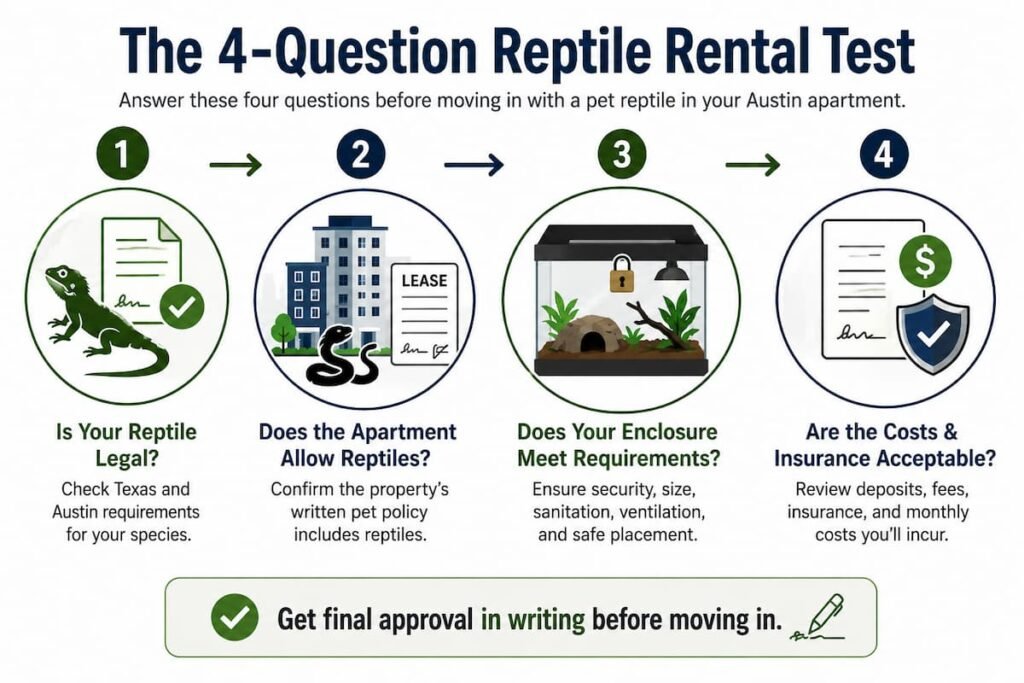
Before applying anywhere, ask the leasing office directly whether reptiles specifically are permitted under the property’s written pet policy, and whether any species, enclosure-size, or insurance restrictions apply. Don’t rely on the word “pet-friendly” alone — get the specific answer for your specific animal.
Austin-Specific Rules to Know
Legal information last verified: August 2026.
Quick answer: if you’re searching for reptile friendly apartments in Austin, the legal side is usually the easy part — most common pet reptiles face no state or city ban. Austin adds general animal-care rules (no running at large, no excessive noise, must be kept clean and sanitary) on top of Texas’s baseline, but rarely anything reptile-specific beyond that for ordinary pet-store species.
Austin adds city-level rules on top of the state baseline, primarily through Title 3 of the Austin Code of Ordinances (Animal Regulation), enforced by Austin Animal Services’ Animal Protection Division. The full current code is published at Austin’s official Municode library — we’d recommend checking the current text there directly for any species-specific question, since municipal codes are periodically amended and a page like this one can’t stay current the way the official source can.
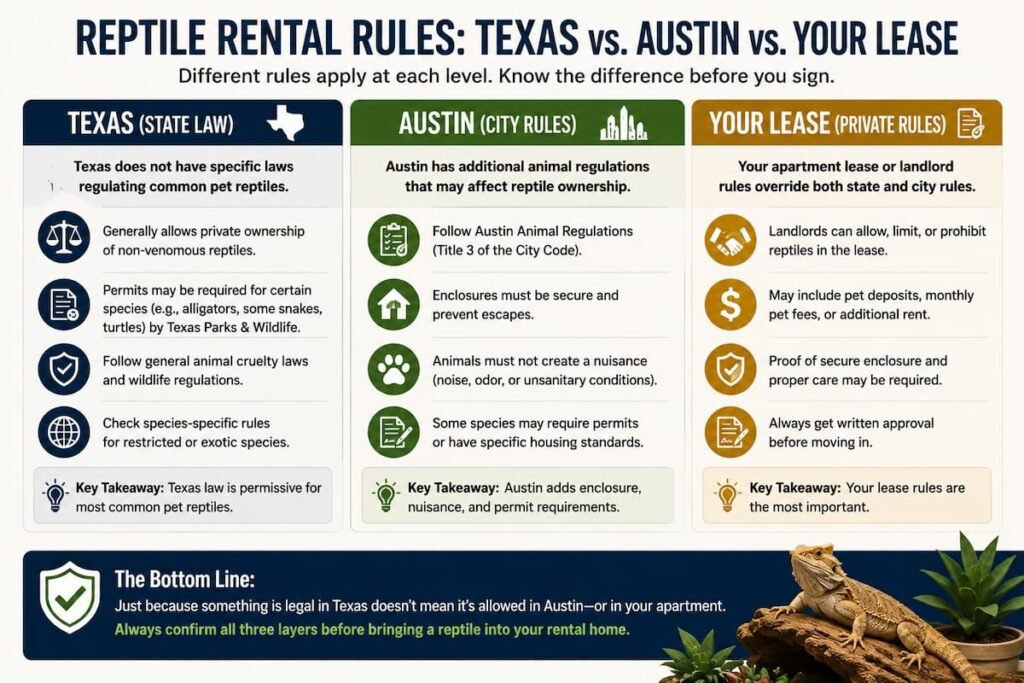
At a general level: Austin restricts ownership of dangerous wild animals (lions, tigers, bears, primates) without special permits. The city’s animal regulation code also sets general standards that apply to reptiles specifically — Austin Code § 3-2-1 prohibits any animal, explicitly including reptiles, from being allowed to “run at large,” § 3-2-2 prohibits keeping an animal that makes excessive or disturbing noise, and § 3-2-5 requires owners to keep animals in a clean, sanitary, and healthy condition with adequate food, water, and medical care. An additional section, § 3-2-11, addresses animal enclosures, though we haven’t been able to independently confirm its exact reptile-specific wording — check the current Austin Code text directly on Municode if you’re setting up an enclosure and want the precise current language.
What this means for a typical reptile owner: for common captive-bred pet reptiles, state and local requirements are generally straightforward. But Austin’s code has its own definitions for restricted and dangerous animals, which aren’t simply a mirror of the state’s Controlled Exotic Snake list — so “not on the state list” shouldn’t be read as “automatically fine in Austin” for anything outside the ordinary pet-reptile category. For species subject to local restrictions or permitting requirements, confirm the current requirements directly with Austin Animal Services before signing a lease.
This section is general information, not legal advice.
What to Expect on Deposits and Fees
Austin properties don’t appear to publish a standardized reptile-specific deposit or fee range — this isn’t itemized by species the way general pet deposits sometimes are. If a property charges a pet deposit or monthly pet rent, ask directly whether the same policy applies to reptiles, whether it’s refundable, and whether the amount differs from what’s charged for a dog or cat. Our broader guide to renting with exotic pets covers the general negotiating approach if a property hasn’t considered reptiles in its fee structure at all.
Enclosure Requirements: What Austin Landlords Actually Care About
This is where general Austin pet guides fall short for reptile owners: the questions that actually come up are about the enclosure, not the animal itself. As covered above, Austin’s code already sets a real baseline — animals can’t run at large (§ 3-2-1), can’t be a source of excessive noise (§ 3-2-2, rarely relevant to reptiles but worth knowing), and must be kept clean, sanitary, and healthy (§ 3-2-5) — and a landlord’s own concerns tend to track closely with that same baseline.
- Escape prevention — a secure, appropriately sized, well-sealed enclosure is the single best answer to a landlord’s biggest unspoken worry
- Sanitation and odor — reptile enclosures are generally low-odor and easy to keep clean compared to many conventional pets, worth mentioning proactively since it isn’t obvious to someone unfamiliar with reptile care
- Size and weight — a large glass terrarium filled with substrate, water, and decor can weigh well over 100 pounds. Building capacities vary, and this isn’t something a general guide can determine for any specific property — for a large enclosure (75+ gallons) or multiple tanks, ask the property manager directly whether the building has any guidance on concentrated loads or oversized aquariums/terrariums, rather than assuming either way based on the building’s age or a unit’s floor level
Bringing these up proactively — rather than waiting for a landlord to ask — is exactly the kind of preparation that builds trust fast in the landlord conversation.
How to Ask an Austin Landlord About Your Reptile
Here’s a version tailored specifically to the concerns a leasing team may have about a reptile:
“I wanted to let you know I have a pet [ball python / bearded dragon / leopard gecko]. She lives full-time in a secure, [size]-gallon enclosure that stays in one location, and the enclosure is designed specifically to prevent escape. I’m happy to provide photos of the setup, care documentation, and any required permits, and I’m glad to comply with the property’s pet terms, sign a pet addendum, and pay any applicable deposit or fee.”
This addresses three concerns a leasing team is likely to have: containment (the “escape” fear), impact on neighbors (relevant given how many Austin communities market shared amenities), and the financial terms of keeping the animal, without requiring them to figure out an unfamiliar fee structure on the spot.
Where to Look: Building Type Matters More Than Neighborhood
Quick answer: finding an apartment that actually accepts reptiles in Austin comes down to asking the right question directly — a written pet policy silent on reptiles isn’t a no, but it isn’t a yes either, so confirm by phone before you apply rather than assuming based on a listing’s general “pet friendly” label.
General Austin pet-friendly guides tend to focus on neighborhood amenities — dog parks, walking trails, pet-friendly patios. For a reptile owner, what to ask matters more than the neighborhood for the one thing that’s actually different about your situation (enclosure weight and placement):
- Large or multiple enclosures: ask the property manager directly whether the building has any guidance on oversized aquariums, terrariums, or concentrated floor loads. Don’t assume a building’s age or a unit’s floor level tells you the answer — treat it as a question to ask, not an assumption to make either way.
- Start with properties whose written pet policies are detailed enough to clarify whether nontraditional pets are considered at all. If reptiles aren’t addressed one way or the other, contact the leasing office before applying rather than guessing based on the policy’s silence.
- A ground-floor unit may make an unusually large enclosure easier to discuss, but it doesn’t automatically eliminate any building or lease restrictions that might apply — it’s a conversation starter, not a workaround.
Reptile Rental Application Checklist
Before you sign a lease, work through this list:
- Confirmed your specific species is permitted (state and city level)
- Confirmed with the leasing office that “pet friendly” includes reptiles specifically, not just dogs and cats
- Got reptile approval in writing, ideally as a signed lease addendum
- Asked whether a pet deposit or monthly pet rent applies, and whether it’s refundable
- Checked the lease itself for species-specific exclusion language
- Asked about enclosure-size guidance, if you’re planning a large tank
- Confirmed whether your renters insurance covers your reptile specifically
- Confirmed whether multiple reptiles are permitted, if relevant
- Photographed your enclosure setup before move-in, for your own records
- Kept any permit documentation accessible, if your species requires one
Finding Specific Austin Properties: What We Can and Can’t Tell You
Last verified: August 2026 — this section describes our research approach and general findings, not a list of specific confirmed properties. See the note below on why.
Here’s an honest limitation worth naming directly: we haven’t called individual Austin leasing offices to build a verified list of which specific properties currently accept reptiles, so we won’t present one here as though it exists — a list like that is only genuinely useful if every entry has actually been confirmed with the property itself, and a fabricated or guessed version would do you more harm than good.
What we’d recommend instead:
- Call, don’t just check the website. Even properties with detailed online pet policies rarely mention reptiles specifically — a two-minute call to the leasing office asking directly is more reliable than any listing filter.
- Start with properties whose written pet policies are detailed enough to clarify whether nontraditional pets are considered. If reptiles aren’t addressed either way, contact the leasing office before applying rather than assuming.
- Use general apartment search sites’ pet filters as a starting point, not a final answer — sites like Zillow, RentCafe, and Apartment List can help you build a shortlist of “pet friendly” properties, which you then confirm individually by phone for reptile-specific policy.
We’re tracking reader-submitted experiences with specific Austin properties — if you’ve successfully rented with a reptile in Austin and are willing to share which property and what the process looked like, get in touch through our main exotic pet rental guide. As verified examples come in, we’ll build a real, dated directory here instead of this general guidance.
Our verification methodology, going forward: we only label a property “reptile-friendly” once its reptile policy has been confirmed either through the property’s own written policy or directly with its leasing team — never inferred or assumed. Every entry we eventually publish will carry its own verification date, since rental policies change and a stale “confirmed” listing is worse than no listing at all.
Our Property Verification Standard
- Confirmed: written property policy, or direct confirmation from leasing staff
- Not enough: generic “pet friendly” marketing language alone
- Verification date: required for every listing before it’s published
- Status shown: Confirmed / Not Confirmed / Policy Unclear
Local Resources for Austin Reptile Owners
Once you’ve found a place, these local resources are worth knowing:
- Austin Herpetological Society — an active local community group for reptile and amphibian keepers, useful for care advice, local vet recommendations, and connecting with other Austin-based keepers
- Exotic-specialized veterinary care — Austin has several practices with genuine reptile expertise. Dr. Brandon Louth, Lead Veterinarian at White Rock Veterinary Hospital, is a published author in exotic veterinary medicine who has presented research at national conferences on avian, reptile, and amphibian medicine, and is currently pursuing ABVP board certification specifically in reptile and amphibian medicine. North Austin Animal Hospital also offers dedicated exotic and reptile veterinary services.
Frequently Asked Questions
Do I need a permit to own a pet snake in Austin?
Only if it falls into Texas’s Controlled Exotic Snake Permit category (certain non-native venomous snakes and specific large constrictor species). Common pet snakes like ball pythons and corn snakes do not require a state permit.
Are ball pythons legal in Austin?
Ball pythons are not among the species listed by Texas Parks and Wildlife for the Controlled Exotic Snake Permit program. Austin’s code has separate provisions concerning animal care and enclosures (see above), so renters should still confirm that their specific setup complies and that the property’s own lease permits the animal.
Are bearded dragons legal in Austin?
Bearded dragons are not subject to Texas’s Controlled Exotic Snake Permit program. Renters should still check the property’s written pet policy and confirm any unusual local requirements before moving in.
Can apartments legally ban reptiles even if they allow dogs and cats?
Yes. A landlord’s lease terms can restrict specific animal types regardless of whether the species is legal to own — legality and lease policy are two separate questions, covered in more detail in our main exotic pet rental guide.
Can a landlord charge a pet deposit for a reptile?
Generally yes, if their lease allows for pet deposits at all — there’s no rule preventing this, and no standardized reptile-specific rate exists publicly, so this is negotiated property by property.
Can I keep multiple reptiles in one Austin apartment?
This depends entirely on the individual lease’s pet-count policy, which is typically written with dogs/cats in mind. Ask directly whether the stated pet limit applies per-animal or per-species, and get the answer in writing.
Should I disclose my reptile before applying, or after being approved?
Before applying, or at latest during the application process — not after move-in. Disclosing upfront is one of the clearest ways to build trust with a landlord; being discovered later, even with a harmless pet, damages that trust in a way that’s hard to repair.
Are there weight limits on reptile tanks in Austin apartments?
There’s no universal rule — it depends on the specific building. Standard-sized enclosures are unlikely to raise concerns; very large or multiple setups are worth a direct question to your leasing office.
Is Austin a good city for reptile owners?
Austin can be a practical city for reptile owners: common pet reptiles can generally be kept without the state permit requirements that apply to controlled exotic snakes, and the city has genuine local veterinary and reptile-keeping resources (below). Your individual species and specific lease still need to be checked — this isn’t a guarantee that applies automatically to every situation.
Part of our complete guide to renting with exotic pets. Have specifics about another Austin building or a species not covered here? Reach out — it helps shape which city guides we prioritize next.
5 thoughts on “Reptile-Friendly Apartments in Austin, TX: A Renter’s Guide (2026)”