
By Nested Exotics Team | Last updated: September 2026
Search “reptile-friendly apartments in Los Angeles” today and you’ll find plenty of pet-friendly listings — but almost nothing that actually addresses reptiles. The results are dominated by general listing sites — Redfin, Zillow, Apartments.com, RentCafe — that treat “pet friendly” as a single undifferentiated category, alongside a scattering of dated local blog posts about dog- and cat-friendly buildings that don’t mention reptiles at all. That gap is what this guide fills, building on our complete guide to renting with exotic pets and applying that framework specifically to the City of Los Angeles. If you’re comparing cities, see our Austin, Denver, Phoenix, Las Vegas, and Chicago reptile rental guides as well.
A scope note before we start, and an important one for this city specifically: “Los Angeles” isn’t a single legal jurisdiction. This guide covers the City of Los Angeles specifically — its own municipal code, permits, and tenant-protection ordinances. It does not cover the dozens of separately incorporated cities that sit inside Los Angeles County (Santa Monica, Pasadena, Long Beach, Glendale, Burbank, Beverly Hills, West Hollywood, and many others), each of which has its own municipal code that can differ meaningfully from the City of LA’s. If you’re apartment-hunting in one of those cities, verify its rules separately rather than assuming City of LA rules apply.
This guide also focuses on commonly kept, captive-bred reptiles — ball pythons, corn snakes, bearded dragons, leopard geckos, and similar pet-store species; requirements can differ substantially for venomous species, large constrictors, or crocodilians.
Legal-information note: animal and housing rules can change, and local requirements can depend on the specific species and circumstances. This guide is informational, not legal advice. Verify unusual or regulated species, and anything involving a permit application, directly with the relevant agency before relying on anything here.
In This Article
Quick Answer: Are Reptile-Friendly Apartments in Los Angeles Available?
Finding reptile-friendly apartments in Los Angeles requires checking a property’s written pet policy directly, but Los Angeles adds several city-specific legal and tenant-protection rules that are important to understand before you start touring.
Some housing in the City of Los Angeles may allow reptiles, but individual properties need to be verified because “pet friendly” does not necessarily include reptiles. California’s restricted-species rules do not list most common pet-trade reptiles.
The City of Los Angeles, however, has a broadly worded permit ordinance that, read literally, can appear to cover non-domestic reptiles — and, working in the other direction, the city also has a tenant-protection rule that may provide additional protection for a pet already kept and allowed under the tenancy. Both are covered in detail below.
Looking for a verified property list? We don’t publish unverified “reptile-friendly” apartment listings. Our standard requires current written confirmation from the property or its leasing staff before a listing counts as Confirmed (see our verification standard below). Until that evidence exists for a specific building, use the verification process in this guide instead of relying on a generic “pet friendly” label.
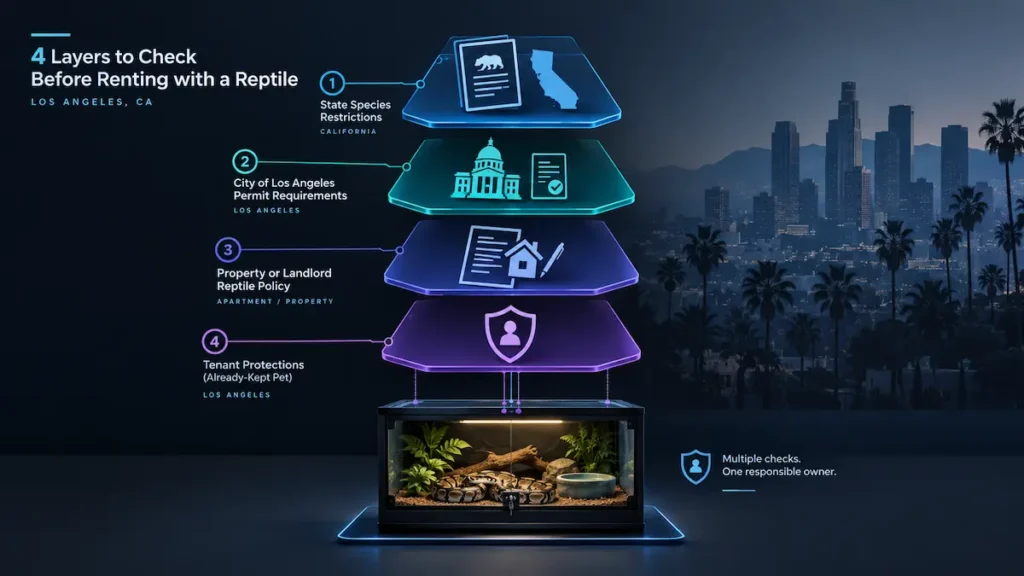
The Four Layers That Actually Govern Your Reptile
Los Angeles doesn’t have one “reptile law.” There are several layers, and each one is verified differently. Skim this table first, then read the sections below for detail.
| Question | Who/what controls it? | What to verify |
|---|---|---|
| Is the species restricted? | State of California | Fish and Game Code §671 restricted-species list |
| Does a city permit apply? | City of Los Angeles | LAMC §53.38–53.39 + LA Animal Services Permit Section |
| Are reptiles allowed in the unit? | The property/landlord | The property’s written pet policy |
| Is an already-approved pet protected later? | City of LA tenant law | RSO/JCO coverage and whether the pet was already kept and allowed |
| Does the county pet-housing rule apply? | LA County | Whether the building is County/LACDA-financed and in an unincorporated area |
How We Verify Reptile-Friendly LA Apartments
Last verified: September 2026 — this section describes our research approach and general findings, not a list of specific confirmed properties.
We haven’t called individual Los Angeles leasing offices to build a verified list of which specific properties currently accept reptiles, so we won’t present one here as though it exists. What we can tell you, based on actual research for this guide, is that reptile exclusions are real and documented at specific LA housing operators (see the HACLA example below), and that the City of LA’s own permit ordinance carries a genuine, unresolved ambiguity for reptile owners that’s worth verifying directly rather than assuming either way.
Not all evidence is equal. As you research on your own, it’s worth weighing evidence in tiers:
Level 1 — Confirmed
- A signed lease or pet addendum
- The property’s own written pet policy stating reptiles are permitted
- An email or other written confirmation from the leasing office
Level 2 — Policy Unclear
- “Pets allowed” language that doesn’t mention reptiles specifically either way
Level 3 — Not Verified
- A generic “pet friendly” label on a listing site
- A leasing agent’s verbal “probably fine”
- A comment on Reddit, social media, or an old review
We’re tracking reader-submitted experiences with specific Los Angeles properties — if you’ve successfully rented with a reptile in the City of LA and are willing to share which property and what the process looked like, get in touch through our main exotic pet rental guide. As verified examples come in, we’ll build a real, dated directory here instead of this general guidance.
Our property verification standard:
- Confirmed: written property policy or direct leasing-staff confirmation states reptiles are permitted
- Prohibited: written property policy explicitly excludes reptiles
- Policy Unclear: property doesn’t clearly address reptiles either way
- Not Verified: no reliable current evidence obtained; generic “pet friendly” marketing language alone doesn’t count
- Verification date: required for every listing before it’s published
Can I Rent an LA Apartment With My Reptile? A Quick Decision Path
- Is your species restricted under California’s Fish and Game Code §671? → covered below (spoiler: for most common pet reptiles, no)
- Does the City of LA’s wild-animal permit ordinance apply to your species in practice? → covered below — this one needs direct verification, not assumption
- Does the property’s written pet policy address reptiles specifically? → covered below
- Have you gotten reptile approval in writing before signing the lease or moving in? → especially useful in LA because it creates evidence that the reptile was kept and allowed under the tenancy
- Do you know whether your building falls under LA’s Rent Stabilization Ordinance or Just Cause Ordinance? → covered below, since it affects how protected your approved pet actually is
- Have you confirmed deposit/fee terms, insurance, and enclosure requirements? → covered in the checklist below
Each step is addressed in order through the rest of this guide.
What California State Law Actually Regulates
California regulates live animal possession primarily through the Fish and Game Code and its implementing regulations — Title 14, California Code of Regulations, Section 671 — administered by the California Department of Fish and Wildlife (CDFW). Section 671 designates a list of “restricted species” that cannot be imported, transported, or possessed without a permit, and the department does not generally issue such permits for private pet possession.
For the common pet reptiles discussed in this guide, the relevant restricted-species provisions do not list ball pythons, corn snakes, boa constrictors, bearded dragons, or leopard geckos. The regulation also identifies crocodilian species within the restricted-species framework. Other state, local, importation, species-specific, or jurisdictional requirements may still apply to a particular animal.
One clause worth flagging directly, because it explains why the rest of this guide exists: the regulation itself states that “cities and counties may also prohibit possession or require a permit for these and other species not requiring a state permit.” California’s restricted-species framework doesn’t reach most common reptiles — but it explicitly leaves the door open for a city like Los Angeles to be stricter. That is why the City of Los Angeles rules need to be examined separately.
This section is general information, not legal advice.
City of Los Angeles Rules You Need to Know
Legal information last verified: September 2026.
This is the section that needs the most care, because the literal text is broader than you might expect — and we want to be precise about what we know and don’t know, rather than either alarming you or glossing over it.
The Los Angeles Municipal Code, Section 53.38, states: “No person shall have, keep or maintain any wild, exotic, dangerous or non-domestic animal or reptile without first applying to and receiving from the Department a permit so to do.” LA Animal Services’ own permits page defines “Wild Animal” the same way: “the keeping or maintaining of any wild, exotic, dangerous, or non-domestic animal or reptile,” and states that a person bringing a wild animal into the City must obtain a wild-animal permit.
A related provision, LAMC §53.39, gives the Department authority to issue those permits and to impose caging, security, and other conditions on permits it grants.
Read literally, that definition doesn’t carve out common pet-store reptiles by size or species the way, for example, LA’s own separate exhibition ordinance does elsewhere in the code (which specifically distinguishes non-venomous reptiles under and over 8 feet for exhibition purposes). On its face, the permit-keeping section could be read to cover a corn snake as readily as a Burmese python, since reptiles generally aren’t classified as a domesticated order.
But that’s a textual observation, not a conclusion about enforcement: the code’s wording is broad, and that breadth does not by itself establish how LA Animal Services interprets or enforces it for ordinary captive pet reptiles.
What we don’t know, and want to be upfront about: we found no published enforcement guidance, FAQ, or public statement from LA Animal Services clarifying how this permit requirement is actually applied to someone keeping a single leopard gecko or ball python in a secure apartment enclosure. We’re not going to guess at enforcement practice we can’t verify, in either direction — we won’t tell you it’s obviously fine because “nobody enforces it that way,” and we won’t tell you it’s obviously required either.
What we recommend instead: before signing a lease with a reptile in the City of Los Angeles, contact LA Animal Services’ Permit Section directly and ask how the wild-animal permit requirement applies to your specific species. This is one of the few places in this whole series where we’d say: don’t rely on general guidance like this article for the answer — get it from the department itself, in writing if possible, before you sign.
This section is general information, not legal advice.

A Key LA Tenant Protection: Pets Already Allowed Under the Tenancy
This is one of the most genuinely useful, LA-specific pieces of information in this guide — and it creates a potentially important protection for an already-kept-and-allowed pet, which contrasts with the permit ambiguity above.
The City of Los Angeles has separate tenant-protection ordinances that can matter here: the Rent Stabilization Ordinance (RSO), which generally covers qualifying rental units built on or before October 1, 1978, and the Just Cause Ordinance (JCO), which covers most residential properties not regulated by the RSO, subject to its own eligibility rules and exemptions.
Both ordinances contain pet-related protections. Under LAMC §151.09(D), a landlord cannot change the terms of an RSO tenancy to prohibit pets and then evict a tenant for keeping a pet that was kept and allowed before the change, unless the landlord establishes that the pet constitutes a nuisance and the nuisance has not been abated after proper notice. The JCO contains a corresponding pet provision in LAMC §165.03(B)(4), while the specific RSO and JCO provisions and their eligibility rules should be checked for the property in question.
It’s worth being precise about what the statute actually protects. The legal rule is that the ordinance protects a pet “kept and allowed” before a prohibition change — it doesn’t, on its own wording, require documented written approval as a legal prerequisite.
The practical recommendation is separate: getting approval in writing is what gives you strong, provable evidence that the animal was in fact kept and allowed before any later policy change, which matters a great deal if a dispute ever comes down to your word against a new property manager’s. In most of the cities in this series, a landlord’s willingness to allow your reptile is essentially a policy — something that can be true today and different tomorrow.
In the City of Los Angeles, an already-kept-and-allowed pet may have protection against a later change in the property’s pet policy, subject to the ordinance’s conditions and exceptions.
Two things worth stating clearly so you don’t over-rely on this protection: it protects a pet that was already kept and allowed before a policy change — it does not give you the right to introduce a new reptile into a unit that currently has a written no-pets policy.
And RSO/JCO coverage is not automatic protection for any reptile in any building: the rule applies to units covered by the RSO or JCO specifically, it comes with the nuisance exception noted above and other statutory conditions, and a small percentage of exempted property types fall outside both ordinances entirely. If in doubt about your building’s coverage, the LA Housing Department’s Just Cause for Eviction Ordinance page and RSO overview page are the places to check.
The practical takeaway: get your reptile approved in writing as early as possible in your tenancy. Asking for written approval is especially valuable here because it creates clear evidence that the reptile was allowed before any later policy change — evidence you may need if that policy ever changes.
LA County’s Pet-Friendly Housing Ordinance (and Its Narrow Scope)
You may come across references to Los Angeles County’s Ordinance No. 2020-0001, the “Pet-Friendly Housing” ordinance (LA County Municipal Code, Division 3, Chapter 8.70), which defines “Pet” to include an animal kept in an aquarium or appropriate enclosure, such as a fish, frog, or non-venomous reptile less than six feet in length — a genuinely reptile-inclusive definition.
It’s worth understanding exactly what this ordinance does and doesn’t cover, because its scope is easy to overstate. It applies specifically to new or rehabilitated multifamily housing financed in whole or in part by LA County or the LA County Development Authority (LACDA), located in the unincorporated areas of LA County — not the City of Los Angeles, which is a separate government with its own code (covered above), and not the county’s other incorporated cities either.
If you’re renting within the City of LA itself, this ordinance doesn’t directly apply to your unit. It is useful if your apartment search extends into the specific unincorporated, County/LACDA-financed housing covered by the ordinance.
Before You Apply: The Right Order of Questions
- Identify your species precisely — common name and, ideally, scientific name
- Check California’s restricted-species list under Fish and Game Code §671 for that species — most common pet reptiles fall outside it
- Confirm whether the property is within City of LA limits — or one of the many separately incorporated cities in the county, which have their own rules
- If it’s within City of LA limits, contact LA Animal Services’ Permit Section directly about your specific species before assuming the general permit ordinance doesn’t apply to you
- Read the specific property’s written pet policy before touring or applying — not just its general “pet friendly” marketing
- Contact the leasing office directly if the policy doesn’t explicitly address reptiles either way
- Get written confirmation — an email or lease addendum, not just a verbal yes
- Check whether your building is covered by LA’s RSO or JCO, since that affects how protected your approved pet will be later
- Review the actual lease or pet addendum before signing
- Document your enclosure and confirm insurance before move-in
Pet-Friendly Doesn’t Always Mean Reptile-Friendly
This is the single most important practical point in this guide, and it holds in Los Angeles just as much as anywhere else in this series.
A clean, documented example: the Housing Authority of the City of Los Angeles (HACLA)’s own published pet and animal rules state directly that “animals prohibited as Pets include but are not limited to: reptiles, rodents, rabbits, turtles, insects, snakes, monkeys, primates, farm animals, wild or exotic animals, endangered species.” That’s a primary source from a major public housing operator, not a secondhand summary — and it means reptiles are explicitly excluded as pets under the HACLA animal rules that apply to HACLA-owned properties, regardless of how “pet friendly” public housing programs are sometimes assumed to be.
At the same time, it would be inaccurate to treat this as proof that every LA property excludes reptiles. Private landlords and property managers may have their own reptile policies at individual buildings; the point isn’t that Los Angeles is uniformly restrictive, but that a general “pet friendly” reputation — in either direction — doesn’t tell you the reptile-specific answer for the exact building you’re considering. Ask the leasing office directly whether reptiles specifically are permitted under the property’s current written pet policy, and get the answer in a form you can point back to later — which matters even more in LA given the tenant-protection rule covered above.
One important distinction worth naming clearly: an ordinary pet reptile is legally different from an assistance or emotional support animal, which falls under separate federal, state, and local disability-accommodation law. This guide covers ordinary pet ownership, not disability-related housing accommodations.
What to Expect on Deposits and Fees
Los Angeles properties don’t appear to publish a standardized reptile-specific deposit or fee schedule — this isn’t itemized by species the way general dog/cat fees sometimes are.
One statewide rule worth knowing regardless of species: under California Civil Code §1950.5, as amended by Assembly Bill 12, a landlord’s total refundable security deposit is generally capped at one month’s rent for deposits collected on or after July 1, 2024, regardless of whether the unit is furnished or unfurnished. There’s a narrower exception: a landlord who is a natural person (or an LLC whose members are all natural persons) and who owns no more than two residential rental properties totaling no more than four units may qualify to charge up to two months’ rent.
That exception has additional statutory conditions, including a separate one-month limit for qualifying service members. Security deposits and pet charges are not necessarily the same thing. Ask the landlord whether any refundable pet deposit is being treated as part of the statutory security deposit, and separately ask about any nonrefundable pet fee or recurring pet rent. Get the charges and their purpose in writing before signing. Our broader guide to renting with exotic pets covers the general negotiating approach if a property hasn’t considered reptiles in its fee structure at all.
Enclosure Considerations: LA’s Climate and Earthquakes
A few genuinely Los Angeles-specific practical factors are worth planning around, separate from anything legal:
- LA’s mild climate is actually an advantage compared to several other cities in this series — you’re less likely to face the extreme heating-cost or winter power-outage concerns that come up in colder climates. That said, secure, stable temperature control still matters for any reptile enclosure.
- Earthquake preparedness is a real LA-specific consideration. Because earthquakes are a recurring hazard in Southern California, a secured, well-anchored enclosure — with the same seismic-safety thinking you’d apply to bookshelves or water heaters — is worth planning for in advance, reducing the risk of an enclosure toppling or cracking during a significant shake.
- Have a general evacuation plan for your reptile, independent of any specific ordinance: a secure, portable carrier sized for your animal, and a plan for temperature control during transport, worked out in advance rather than improvised during an emergency. Reptiles can’t simply be carried out the way a cat or small dog can, especially larger enclosures, so this is worth thinking through regardless of the cause of an evacuation.
- Escape prevention and sanitation remain what actually matters most to a landlord, regardless of any of the above — a secure, well-maintained enclosure addresses both directly.

How to Ask an LA Landlord About Your Reptile
“I wanted to let you know I have a pet [ball python / bearded dragon / leopard gecko]. My reptile lives full-time in a secure, [size]-gallon enclosure that stays in one location and is specifically designed to prevent escape. I’m happy to provide photos of the setup, care documentation, and any required permits, and I’m glad to comply with the property’s pet terms, sign a pet addendum, and pay any applicable deposit or fee. I’d also appreciate getting that approval in writing, both for my records and yours.”
That last line matters in Los Angeles because written approval is one of the clearest forms of evidence that your reptile was kept and allowed under the tenancy — which is the fact the tenant protection covered above actually turns on.
Reptile Rental Application Checklist
- Confirmed your specific species falls outside California’s Fish and Game Code §671 restricted-species list
- If renting within City of LA limits, contacted LA Animal Services’ Permit Section directly about your species
- Confirmed the property is within City of LA limits, not a separately incorporated city with its own code
- Confirmed with the leasing office that “pet friendly” includes reptiles specifically, not just dogs and cats
- Got reptile approval in writing, ideally as a signed lease addendum
- Confirmed whether your building is covered by LA’s RSO or JCO
- Asked whether a pet deposit or monthly pet rent applies, and how it interacts with California’s overall security deposit cap
- Confirmed whether your renters insurance covers your reptile specifically
- Prepared an earthquake-safe enclosure setup and a general evacuation plan for your animal
- Photographed your enclosure setup before move-in, for your own records
- Kept any permit documentation accessible, if applicable to your species
Local Resources for LA Reptile Owners
- Southwestern Herpetologists Society — founded in 1954, with chapters serving the Los Angeles area (contact the society directly for current meeting location and schedule, which have shifted over the organization’s history). A long-running, established local community for reptile and amphibian enthusiasts.
- Southern California Herpetology Association & Rescue — a nonprofit focused on reptile education, conservation, and rescue, based in Buena Park, in the greater LA/Orange County area.
- Exotic-specialized veterinary care — multiple LA-area practices offer dedicated reptile and exotic veterinary services, including Center Sinai Animal Hospital (10737 Venice Blvd, Los Angeles), which has provided care for snakes, turtles, tortoises, and other exotics alongside cats and dogs since 1969.
Frequently Asked Questions
Do I need a permit to own a pet snake in Los Angeles?
Under California state law, most common pet-trade snakes — including ball pythons and corn snakes — are outside the state’s restricted-species list. The City of Los Angeles is a separate question: LAMC §53.38 broadly prohibits keeping a “wild, exotic, dangerous or non-domestic animal or reptile” without a Department permit, and LAMC §53.39 gives the Department authority over those permits.
LA Animal Services also describes a “Wild Animal” as the keeping or maintaining of a wild, exotic, dangerous, or non-domestic animal or reptile. Because we did not find published City guidance explaining how these provisions are applied to ordinary captive pet snakes, confirm the requirement for your specific species directly with LA Animal Services before relying on a general state-law answer. Your property’s written pet policy must also be confirmed separately.
Are ball pythons legal in Los Angeles?
Under California state law, ball pythons are not listed among the state’s restricted species. That does not by itself resolve the separate City of Los Angeles question: LAMC §53.38 uses broad language covering wild, exotic, dangerous, or non-domestic animals or reptiles, and the City does not appear to publish species-specific guidance explaining how that provision is applied to an ordinary pet ball python. If you are keeping one within City limits, confirm the local requirement directly with LA Animal Services and separately obtain written approval from the property before moving in.
Are bearded dragons legal in Los Angeles?
Under California state law, bearded dragons fall outside the state’s restricted-species list. The City of Los Angeles has a separate, broadly worded permit provision covering wild, exotic, dangerous, or non-domestic animals or reptiles, but we did not find published City guidance explaining how that provision is applied to an ordinary pet bearded dragon. If you are keeping one within City limits, confirm the local requirement directly with LA Animal Services and separately confirm that the property’s written pet policy permits reptiles.
Can a Los Angeles landlord evict me for having a reptile they didn’t previously object to?
If your reptile was already kept and allowed under your tenancy and your unit is covered by LA’s Rent Stabilization Ordinance or Just Cause Ordinance, a landlord generally can’t change the lease terms to newly prohibit pets and then use that change as grounds for eviction — unless they can show the pet has become a documented nuisance that wasn’t corrected after notice (LAMC §151.09(D)). Written approval is strong evidence that the pet was kept and allowed, which is why we recommend getting it.
This protection applies to already-allowed pets, not to introducing a new pet against a current no-pets policy, and doesn’t apply to properties outside RSO/JCO coverage. More detail in our main exotic pet rental guide.
Does LA County’s pet-friendly housing ordinance mean I can keep a reptile anywhere in Los Angeles?
No — this is a common point of confusion. LA County’s Ordinance No. 2020-0001 applies specifically to new or rehabilitated multifamily housing financed by the County or LACDA, located in unincorporated areas of LA County. It doesn’t apply to the City of Los Angeles, which is a separate government with its own rules (covered above), and it doesn’t apply to the county’s other incorporated cities either.
Should I disclose my reptile before applying, or after being approved?
Before applying, or at latest during the application process — not after move-in. This matters even more in Los Angeles: written, documented approval is strong evidence that a reptile was kept and allowed under the tenancy, which is exactly the fact the city’s tenant-protection rule turns on — so getting it in writing upfront isn’t just good practice, it’s a real safeguard.
What should reptile owners consider when renting in Los Angeles?
Several layers, not one rule: whether the species is on California’s restricted list (most common pet reptiles aren’t), whether the City of LA’s wild-animal permit ordinance applies in practice to your species (verify directly with LA Animal Services), whether the specific property’s written pet policy covers reptiles, whether the building falls under LA’s RSO or JCO and what that means for an already-allowed pet, and practical factors like earthquake-safe enclosure setup, general evacuation planning, and confirmed exotic-veterinary access in the area.
Part of our complete guide to renting with exotic pets. Have specifics about a City of LA property, a neighboring incorporated city’s rules, or direct experience with LA Animal Services’ permit process? Reach out — reader input directly shapes which city and topic guides we prioritize next.