

By Nested Exotics Team | Last updated: September 2026
Search “reptile-friendly apartments in Chicago” today and you’ll find plenty of pet-friendly listings — but surprisingly little guidance about whether those properties actually allow reptiles. The results are pet-friendly listing aggregators — Apartments.com, Zillow, Rent.com — that treat “pet friendly” as a single category covering dogs, cats, and everything else by implication. One popular Chicago pet blog gets closer, noting in passing that exotic pets like reptiles “tend to face more restrictions” than cats and dogs — and then moves on without saying what those restrictions actually are, where they come from, or what to do about them.
That gap is what this guide fills.
This guide builds on our complete guide to renting with exotic pets and applies that framework specifically to Chicago. If you’re comparing cities, see our Austin, Denver, Phoenix, and Las Vegas reptile rental guides as well — Chicago’s mix of state law, municipal code, and (uniquely among this series) condo association bylaws makes it a genuinely different case from any of them.
A scope note before we start: this guide focuses on commonly kept, captive-bred reptiles — ball pythons, corn snakes, bearded dragons, leopard geckos, and similar pet-store species. Requirements can differ substantially for venomous species, large constrictors, native or wild-caught species, or any animal subject to additional federal, state, or local restriction. If you own one of those, the general guidance here still applies, but verify your specific species separately rather than assuming it’s covered by anything below.
Legal-information note: animal ownership rules can change, and local requirements can depend on the specific species and circumstances. This guide is informational, not legal advice. Verify unusual or regulated species directly with the Illinois Department of Natural Resources and Chicago Animal Care and Control before relying on anything here.
In THis Article
Quick Answer: Are Reptile-Friendly Apartments in Chicago Available?
Finding reptile-friendly apartments in Chicago requires checking the property’s written animal policy rather than relying on a generic “pet friendly” label — the same rule that applies in every city in this series, but with an extra wrinkle here.
Yes, you can find reptile-friendly apartments in Chicago. Illinois state law is actually more permissive toward common pet reptiles than several other states in this series: ball pythons, corn snakes, bearded dragons, and similar captive-bred species generally fall outside the state’s permit requirements. Your real hurdle in Chicago is a written property policy — plus a layer that barely exists in Sunbelt rental markets: condo association bylaws, since roughly one in five Chicago homes is a condo. Both are covered in detail below.
Can I Rent a Chicago Apartment With My Reptile? A Quick Decision Path
- Is your species regulated or exempt under Illinois’s Herptiles-Herps Act? → covered below
- Does your species fall under the separate Dangerous Animals Act (venomous, or a genuinely large/dangerous constrictor)? → covered below
- Does Chicago’s municipal code add anything on top of state law? → covered below
- Is the unit a straight rental or a condo? → this changes which document governs, covered below
- Does the property’s written pet policy — or the condo association’s bylaws — actually address reptiles? → covered below
- Have you gotten written confirmation, checked deposit/fee terms, and confirmed insurance and enclosure requirements? → covered in the checklist below

Each step is addressed in order through the rest of this guide — if you only read one section, make it whichever step you’re currently stuck on.
What Illinois Law Actually Regulates
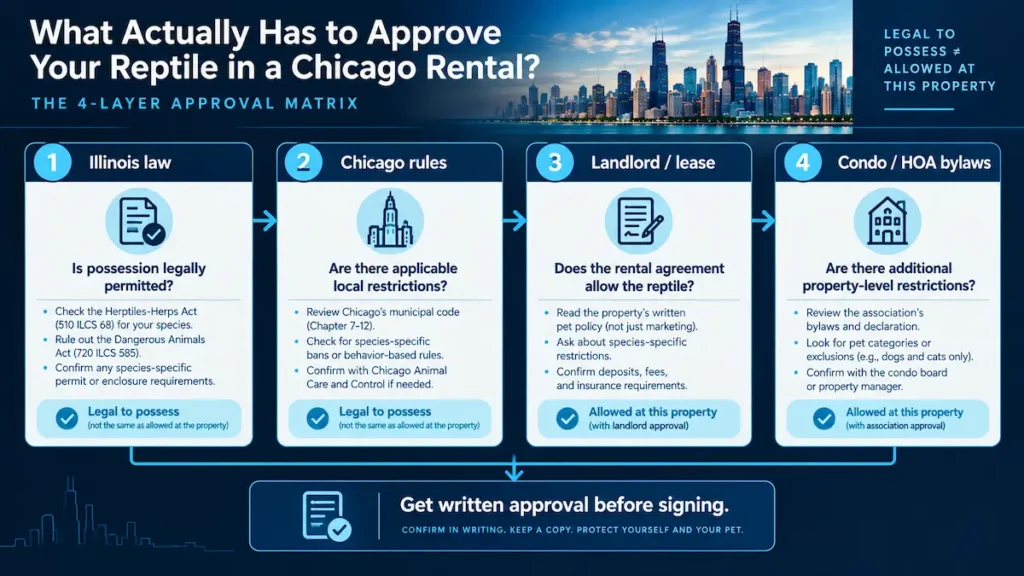
Illinois regulates reptiles through two separate statutes that don’t always get distinguished clearly in general “exotic pet law” summaries — and the distinction actually matters for anyone renting in Chicago.
The Herptiles-Herps Act (510 ILCS 68), administered by the Illinois Department of Natural Resources, is the primary law governing reptile and amphibian possession. It’s organized by species category — venomous reptiles, boas/pythons/anacondas, crocodilians, monitor lizards, turtles, amphibians — each with its own article. The practical headline for most pet owners: boas, pythons, and anacondas in the Boidae family — which includes ball pythons — are explicitly exempt from any permit, fee, or liability insurance requirement under the Act’s own text.
Other commonly kept, non-native, non-venomous pet-store species — corn snakes, bearded dragons, leopard geckos, crested geckos — likewise fall outside the Act’s permit-requiring categories (venomous reptiles, crocodilians, monitor lizards, and certain native/special-use herptiles). That covers the large majority of what a typical renter actually keeps. It’s still worth confirming your exact species against the Herptiles-Herps Act’s article list directly if you own something less common, since the Act is organized by category rather than a single blanket rule.
The separate Illinois Dangerous Animals Act (720 ILCS 585) is where actual restriction shows up. It prohibits possession of “any poisonous or life-threatening reptile” statewide, alongside a list of big cats and other dangerous mammals. The word “life-threatening” isn’t defined by species name in the statute itself — which sounds vague, but it’s been tested directly by Illinois courts, and the case is a Chicago one.
In People v. Fabing (143 Ill. 2d 48 (1991)), the Illinois Supreme Court considered a Cook County defendant who was convicted of possessing four “life-threatening” reptiles under the Act: a four-foot alligator, a seven-foot boa constrictor, and two Burmese pythons roughly 15 to 20 feet long. The court’s actual holding is more precise — and more useful — than a simple “big snakes are illegal” takeaway:
It found the Act facially valid and upheld it as applied to the two large pythons, but ruled the same “life-threatening” standard too ambiguous to sustain a conviction for the seven-foot boa constrictor, since the state’s own expert witnesses disagreed on whether a boa that size qualified, and a state regulation the prosecution relied on (treating any constrictor over six feet as life-threatening) didn’t actually govern this statute.
The court explicitly declined to set a bright-line size or species rule. That’s the opposite of a simple threshold, and it’s the important takeaway here: don’t read this case as establishing “six feet” or “fifteen feet” as a legal cutoff, because the court itself rejected that kind of fixed standard.
What this means for a typical reptile owner: a typical captive-bred ball python, corn snake, leopard gecko, or bearded dragon is materially different from the unusually large animals at issue in Fabing, and isn’t venomous — so this statute is very unlikely to affect a typical renter’s animal. It becomes a real question only if you’re keeping (or considering) a genuinely large constrictor, a crocodilian, or a venomous species — and given that even the Illinois Supreme Court found the line genuinely hard to draw at the edges, that’s a determination worth getting from a qualified source for your specific animal, not from a general guide like this one.
One more layer worth knowing about, since it explains why Chicago’s rules can differ from the rest of Illinois: the Herptiles-Herps Act expressly allows a municipality or county to adopt an ordinance governing reptile and amphibian species that is more restrictive than the state framework. Whether Chicago has actually used that authority for reptiles specifically is covered next.
This section is general information, not legal advice.
Chicago-Specific Rules to Know
Legal information last verified: September 2026.
Quick answer: based on our review of the current published code, Chicago’s own animal ordinance (Municipal Code Chapter 7-12) does not appear to ban reptiles by species the way some other cities in this series do — it defines a “dangerous animal” primarily by behavior (biting, attacking, or threatening) rather than by a fixed list of prohibited species. This is a negative claim (that a specific ban does not exist), so we’d encourage confirming it against the current code yourself, or with Chicago Animal Care and Control directly, rather than treating this paragraph as the last word. The species-specific restriction that clearly does apply inside Chicago is the statewide Dangerous Animals Act covered above.
This is a genuinely different structure from what we found researching Denver, where the municipal code names specific prohibited categories (venomous snakes, snakes over six feet, crocodilians) directly. Chicago’s Municipal Code, Chapter 7-12 (“Animal Care and Control”), instead defines a “dangerous animal” under Section 7-12-020 primarily in terms of behavior — an animal that bites, attacks, or exhibits threatening conduct — with the Executive Director of Animal Care and Control empowered to investigate and make that determination on a case-by-case basis under Section 7-12-050, rather than through a pre-set species list specific to the city ordinance itself.
What this means in practice: Chicago’s municipal dangerous-animal provisions are framed around animal behavior and case-specific determinations rather than a simple reptile-species ban. That does not eliminate the separate state-law restrictions discussed above — the statewide Dangerous Animals Act’s “life-threatening reptile” prohibition still applies inside Chicago, and the Herptiles-Herps Act expressly permits municipalities and counties to adopt more restrictive rules governing reptile and amphibian species, so a genuinely large constrictor or venomous species remains a real legal question regardless of what Chicago’s own municipal code does or doesn’t list by name.
For the current, authoritative text of Chicago’s animal ordinance, check the Municipal Code of Chicago, Chapter 7-12 directly, or contact Chicago Animal Care and Control — municipal codes are amended periodically, and a page like this one can’t stay current the way the official source can.
This section is general information, not legal advice.
Before You Apply: The Right Order of Questions
It helps to work through these in sequence, rather than all at once:
- Identify your species precisely — common name and, ideally, scientific name, since regulatory treatment depends on the exact species
- Check Illinois’s state-level rules for that species under the Herptiles-Herps Act (covered above)
- Rule out the Dangerous Animals Act — confirm your species isn’t a venomous or genuinely large constrictor species this statute would cover
- Check whether your target property is a straight rental or a condo/co-op unit — this changes which document actually governs (covered below)
- Read the specific property’s written pet policy, or the condo association’s bylaws, before touring or applying — not just its general “pet friendly” marketing
- Contact the leasing office or condo board directly if the policy doesn’t explicitly address reptiles either way
- Get written confirmation — an email or lease addendum, not just a verbal yes
- Review the actual lease, pet addendum, or association rules before signing — this is the document that legally governs your tenancy, not a marketing page or a verbal assurance
- Document your enclosure and confirm insurance before move-in, so you have your own records from day one
Pet-Friendly Doesn’t Always Mean Reptile-Friendly
This is the single most important practical point in this guide, and it holds true in Chicago just as much as in the other cities we’ve covered — arguably more so, given how much of Chicago’s housing stock is institutionally or academically managed with its own specific pet rules.
A clean, documented example: the University of Chicago’s own Real Estate Operations pet policy — which governs faculty, staff, and graduate student housing across a large number of Hyde Park and nearby properties — states directly that “pets allowed in apartments are limited to dogs and cats.” That’s a primary source, not a secondhand summary, and it means reptiles are excluded by definition at every property this policy covers, regardless of how “pet friendly” the housing may otherwise seem.
At the same time, it would be inaccurate to present Chicago as uniformly restrictive — the University of Chicago example is one documented data point, not proof that every Chicago property excludes reptiles. Some large, corporately managed Chicago operators do permit reptiles at specific properties; the point of this guide isn’t to claim otherwise, but to insist on the same standard either way: a general “pet friendly” reputation, in either direction, doesn’t tell you the reptile-specific answer for the exact building you’re considering. Ask the leasing office directly whether reptiles specifically are permitted under the property’s current written pet policy, and get the answer in a form you can point back to later.
One important distinction worth naming clearly: an ordinary pet reptile is legally different from an assistance or emotional support animal, and the two shouldn’t be conflated. Housing protections for assistance animals fall under separate federal, state, and local disability-accommodation law with their own requirements and processes — this guide covers ordinary pet ownership, not disability-related housing accommodations. If that situation applies to you, it’s worth evaluating separately with a qualified source rather than assuming general pet-reptile guidance applies.
Condos vs. Rental Buildings: Chicago’s Extra Layer
This is the piece of the puzzle that doesn’t come up the same way in Austin, Phoenix, Denver, or Las Vegas, and it’s worth understanding before you start touring units. Condominiums make up 20.0% of all housing units in the City of Chicago, per DePaul University’s Institute for Housing Studies — roughly one in five homes, and a meaningfully larger share of the housing stock than in most of the Sunbelt rental markets we’ve covered in this series, where large, corporately managed apartment complexes dominate.
Why this matters for a reptile owner specifically: a condo unit isn’t governed by a single corporate leasing office’s pet policy the way an apartment complex is. It’s governed by the building’s condo association bylaws and declaration — a separate legal document, usually adopted and amended by a vote of the owners themselves, not written by a professional property management company with a standard template. Illinois law doesn’t prohibit condo associations from restricting or banning pets outright, provided the restriction is actually set out in the association’s governing documents (the declaration, bylaws, or duly adopted rules) rather than imposed as an ad hoc board decision.
What this means in practice:
- If you’re renting a unit from an individual condo owner (rather than renting directly from a large apartment complex), the pet policy that actually governs you may be the condo association’s rules — not just whatever your individual landlord tells you verbally. A landlord who’s personally fine with your gecko may not have the authority to override a building-wide association rule that excludes reptiles.
- Condo association pet rules commonly restrict “pets” to dogs and cats specifically, sometimes explicitly listing exotic animals, birds, reptiles, and rodents as excluded categories — this pattern shows up repeatedly in general Illinois condo/HOA legal guidance, echoing the same “dogs and cats only” framing found in the University of Chicago example above.
- Ask your prospective landlord directly whether the building is a straight rental or a condo, and if it’s a condo, ask to see the association’s current pet rules — not just your individual landlord’s personal comfort level with your animal.
- If you’re renting directly from a large, corporately managed apartment building (the AMLI/Draper and Kramer type of property, more common downtown and in newer developments), this condo-association layer typically doesn’t apply, and the property’s own written pet policy is the relevant document, as in the other cities in this series.
What to Expect on Deposits and Fees
Chicago properties don’t appear to publish a standardized reptile-specific deposit or fee range — this isn’t itemized by species the way general dog/cat pet fees sometimes are. If a property or condo association charges a pet deposit or monthly pet rent, ask directly whether the same policy applies to reptiles, whether it’s refundable, and whether the amount differs from what’s charged for a dog or cat. Our broader guide to renting with exotic pets covers the general negotiating approach if a property hasn’t considered reptiles in its fee structure at all.
Enclosure Considerations: Chicago’s Building Stock and Winters
Two genuinely Chicago-specific practical factors are worth planning around, separate from anything legal:
- Chicago’s housing stock skews older than in newer Sunbelt markets. Vintage two-flats, greystones, and pre-war courtyard buildings make up a large share of the city’s rental inventory, alongside newer high-rises. Electrical capacity for heat lamps and UVB lighting, and floor-load tolerance for a large, fully set-up terrarium, can vary significantly between a century-old walk-up and a modern high-rise — this isn’t something a general guide can determine for any specific building, so for a large enclosure or multiple tanks, ask the property manager or condo board directly rather than assuming based on the building’s age or construction type.
- Chicago winters raise a real transport and power-outage consideration that doesn’t come up in Denver’s dry-but-milder climate or in the Sunbelt cities in this series. Reptiles are especially sensitive to cold, and a Chicago winter cold snap combined with a power outage can create a genuine emergency for a temperature-dependent animal faster than in a warmer climate. Have a backup heat plan (battery-powered options, a plan for temporarily relocating the animal) worked out before your first winter in a new unit, not after a cold snap catches you unprepared.
- Escape prevention and sanitation remain the two things that actually matter most to a landlord or condo board, regardless of building age or type — a secure, well-maintained enclosure addresses both directly, and is worth mentioning proactively.
How to Ask a Chicago Landlord About Your Reptile
Here’s a version tailored specifically to the concerns a Chicago leasing office or condo board may have about a reptile:
“I wanted to let you know I have a pet [ball python / bearded dragon / leopard gecko]. My reptile lives full-time in a secure, [size]-gallon enclosure that stays in one location, and the enclosure is specifically designed to prevent escape. I’m happy to provide photos of the setup, care documentation, and any required permits, and I’m glad to comply with the property’s (or association’s) pet terms, sign a pet addendum, and pay any applicable deposit or fee.”
If you’re renting a condo unit specifically, it’s worth adding one more line: “I understand the building may have its own association rules on pets, and I’m happy to review and comply with those directly as well.” That single addition signals you already understand the condo-specific layer covered above — which is exactly the kind of preparation that can make the conversation easier.
Reptile Rental Application Checklist
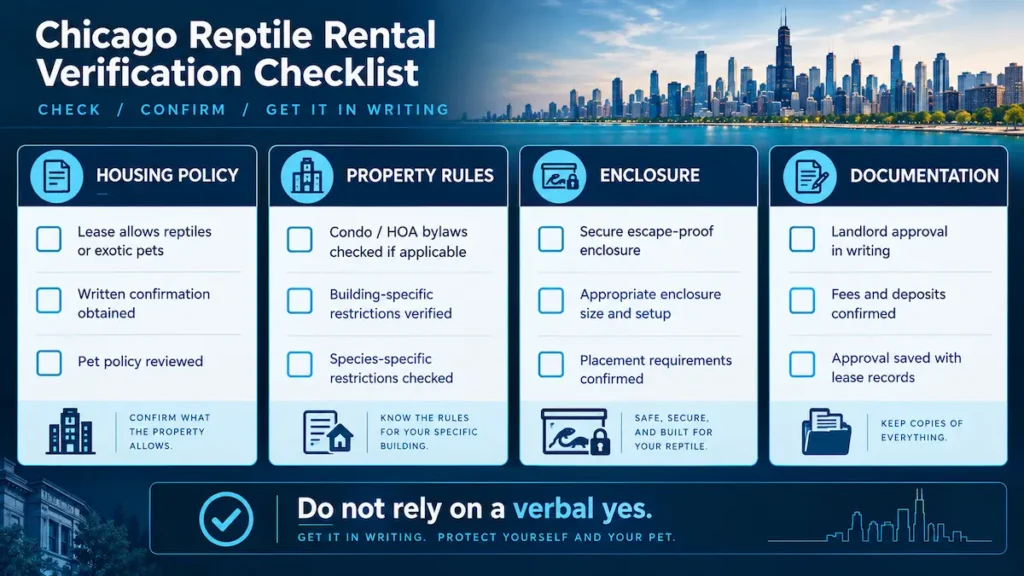
Before you sign a lease, work through this list:
- Confirmed your specific species is permitted under Illinois’s Herptiles-Herps Act and not covered by the Dangerous Animals Act
- Confirmed whether your target property is a straight rental or a condo unit, and identified which document actually governs pet policy
- Confirmed with the leasing office (or condo board) that “pet friendly” includes reptiles specifically, not just dogs and cats
- Got reptile approval in writing, ideally as a signed lease addendum or written board confirmation
- Asked whether a pet deposit or monthly pet rent applies, and whether it’s refundable
- Checked the lease — or condo association rules — for species-specific exclusion language
- Asked about enclosure-size and electrical-load guidance, especially in older buildings
- Confirmed whether your renters insurance covers your reptile specifically — including liability and property damage; don’t assume a simple yes/no answer covers everything
- Confirmed whether multiple reptiles are permitted, if relevant
- Worked out a winter backup-heat plan before your first cold snap
- Photographed your enclosure setup before move-in, for your own records
- Kept any permit documentation accessible, if your species requires one
How We Verify Reptile-Friendly Chicago Apartments
Last verified: September 2026 — this section describes our research approach and general findings, not a list of specific confirmed properties.
Here’s an honest limitation worth naming directly: we haven’t called individual Chicago leasing offices or condo boards to build a verified list of which specific properties currently accept reptiles, so we won’t present one here as though it exists. What we can tell you, based on actual research for this guide, is that reptile exclusions are real and documented at specific Chicago housing operators (see the University of Chicago example above) — this isn’t a market where you can assume acceptance by default, and the condo-association layer adds a source of restriction that doesn’t exist in most of the other cities in this series.
Not all evidence is equal. As you research on your own, it’s worth distinguishing:
- Strong evidence: a signed lease or pet addendum, the property’s own written pet policy, the condo association’s current bylaws, or an email from the leasing office or board
- Weak evidence: a general “pets allowed” label on Zillow or Apartments.com, a leasing agent’s verbal “probably fine,” or a comment on Reddit or an old review
Treat anything short of a written policy or written confirmation as a starting point to verify, not a final answer.
What we’d recommend instead:
- Call, don’t just check the website — but treat a verbal answer as a starting point, not the final word. Directly contacting the leasing office (or, for a condo, the property manager or board) is the best way to resolve an unclear policy; whenever possible, get the answer in writing afterward.
- If the unit is a condo, ask specifically whether you’re getting your landlord’s personal answer or the association’s actual written rule. As covered above, these can differ, and the association’s governing documents can impose restrictions your individual landlord isn’t able to override on their own.
- Use general apartment search sites’ pet filters as a starting point, not a final answer — sites like Zillow, RentCafe, and Apartment List can help you build a shortlist of “pet friendly” properties, which you then confirm individually by phone for reptile-specific policy.
We’re tracking reader-submitted experiences with specific Chicago properties — if you’ve successfully rented with a reptile in Chicago and are willing to share which property and what the process looked like, get in touch through our main exotic pet rental guide. As verified examples come in, we’ll build a real, dated directory here instead of this general guidance.
Our verification methodology, going forward: we only label a property “reptile-friendly” once its reptile policy has been confirmed either through the property’s own written policy or directly with its leasing team — never inferred or assumed. Every entry we eventually publish will carry its own verification date, since rental policies change and a stale “confirmed” listing is worse than no listing at all.
Our Property Verification Standard
- Confirmed: written property policy or direct leasing-staff/board confirmation states reptiles are permitted
- Prohibited: written property policy or association bylaws explicitly exclude reptiles
- Policy Unclear: property or association doesn’t clearly address reptiles either way
- Not Verified: no reliable current evidence obtained; generic “pet friendly” marketing language alone doesn’t count
- Verification date: required for every listing before it’s published
Local Resources for Chicago Reptile Owners
Once you’ve found a place, these local resources are worth knowing:
- Chicago Herpetological Society — a long-running, all-volunteer nonprofit dedicated to reptile and amphibian conservation and education, holding monthly public meetings and the annual ReptileFest event. A genuinely active local community for care advice and connecting with other Chicago-area keepers.
- Exotic-specialized veterinary care — Chicago has multiple practices with real reptile expertise. Chicago Exotics Animal Hospital (Skokie) has specialized in avian and exotic animal care since 2000; its founding veterinarian is a member of the Association of Reptile and Amphibian Veterinarians and has worked with Brookfield Zoo, Lincoln Park Zoo, and the Shedd Aquarium. Animal House of Chicago and Metropolitan Veterinary Center both offer dedicated reptile and exotic veterinary services within Chicago city limits.
Frequently Asked Questions
Do I need a permit to own a pet snake in Chicago?
For most commonly kept pet-trade snakes — including ball pythons, which fall within the Boidae family explicitly exempted from permitting under Illinois’s Herptiles-Herps Act — a state permit generally isn’t required. Permit and registration requirements vary by species and statutory category, though, so venomous or otherwise regulated animals need separate verification rather than assuming the same exemption applies. Chicago’s own municipal code doesn’t add a separate reptile-specific permit requirement on top of state law.
Are ball pythons legal in Chicago?
Yes. Ball pythons fall within the Boidae family that Illinois’s Herptiles-Herps Act explicitly exempts from permitting. The Fabing case discussed above involved exceptionally large Burmese pythons, not an ordinary pet ball python — it’s a different animal by any measure, not a case of falling just under a legal line. A property’s own lease terms, or a condo association’s bylaws, still need to be confirmed separately.
Are bearded dragons legal in Chicago?
Yes. Bearded dragons generally fall outside the Illinois permit-requiring categories applicable to the species discussed in this guide. As with any species, check the specific property’s or condo association’s written pet policy before assuming acceptance.
Can apartments or condo buildings in Chicago legally ban reptiles even if they allow dogs and cats?
Yes. A property’s lease, or a condo association’s bylaws, can restrict specific animal types even when those animals are completely legal to own — this is exactly what the University of Chicago housing example shows above. Whether a particular restriction is enforceable can depend on applicable housing law and the specific tenancy or ownership situation, so legal ownership and contractual/association permission to keep an animal are two separate questions. More detail in our main exotic pet rental guide.
What’s different about renting a condo versus an apartment in Chicago, as a reptile owner?
A condo unit is governed by the building’s condo association bylaws in addition to whatever your individual landlord tells you — and Illinois law allows associations to restrict or exclude pet categories (including reptiles) in their governing documents. The association’s governing documents may impose restrictions that your individual landlord cannot simply override, regardless of the landlord’s own personal comfort with your animal.
An apartment in a corporately managed complex is typically governed by a single, standard written pet policy instead. Always ask which situation applies before assuming your landlord’s personal comfort with your animal is the final word.
Can a landlord or condo association charge a pet deposit for a reptile?
A property or association may apply its existing pet-deposit or pet-fee policy to reptiles if its lease, rules, or bylaws permit it. There’s no standardized reptile-specific rate publicly available, so ask directly how the policy applies to your specific animal and whether the amount is refundable.
Should I disclose my reptile before applying, or after being approved?
Before applying, or at latest during the application process — not after move-in. Disclosing upfront is one of the clearest ways to build trust with a landlord or board; being discovered later, even with a harmless pet, damages that trust in a way that’s hard to repair.
Is Chicago a good city for reptile owners?
Chicago has real advantages: Illinois state law doesn’t require a permit for most commonly kept pet reptiles, and the city has an active, long-running reptile-keeper community along with confirmed exotic-veterinary resources. The trade-off is Chicago’s condo-heavy housing stock, which adds an association-bylaws layer of potential restriction that doesn’t exist in most of the other cities in this series — so your individual species, specific building type, and specific lease or bylaws still need to be checked before you assume anything.
Part of our complete guide to renting with exotic pets. Have specifics about another Chicago building, a condo association policy, or a species not covered here? Reach out — reader questions directly shape which city and species guides we prioritize next.