
By Nested Exotics Team | Last updated: August 2026
Quick answer: Generally, yes. Based on our reading of NAC 503.140(1)(aa), common pet reptiles such as ball pythons, corn snakes, bearded dragons, and leopard geckos are nonvenomous and nonindigenous to Nevada and appear to fall within the state’s category of reptiles that may be possessed without a Nevada Department of Wildlife permit or license.
That state-level exemption doesn’t end the inquiry, though. Keeping one in a Las Vegas-area apartment is a separate question, and it’s more complicated here than in most cities: the Las Vegas metro spans multiple local jurisdictions — including the City of Las Vegas, unincorporated Clark County, North Las Vegas, and Henderson — each with its own animal code. As of August 2026, we’ve verified two Las Vegas-area apartment communities whose published pet policies explicitly name reptiles, and one with an explicit exclusion.
If you’re specifically searching for reptile-friendly apartments in Las Vegas, the most important distinction to understand up front is between a property’s written pet policy and the local jurisdiction governing its address — the two are separate questions, and both matter.
This guide applies our complete framework for renting with exotic pets specifically to the Las Vegas metro. If you’re comparing cities, our Austin, Denver, and Phoenix reptile rental guides use the same evidence standard.
Scope: This guide covers commonly kept, captive-bred reptiles — ball pythons, corn snakes, bearded dragons, leopard geckos, and similar pet-store species. Venomous species, large constrictors, native Nevada wildlife (including the desert tortoise, which is separately protected), and anything on Nevada’s restricted-wildlife list are governed by additional rules not covered here.
Legal-information note: This guide is informational, not legal advice. Rules can change and can depend on the exact species, the exact address, and the circumstances. Verify anything unusual directly with the Nevada Department of Wildlife (NDOW) and the specific city or county where the property is located.
| Question | Answer |
|---|---|
| Common pet reptiles covered by this guide (ball python, corn snake, bearded dragon, leopard gecko) generally lawful to possess? | Based on our reading, generally yes — all four are nonvenomous and nonindigenous to Nevada, which appears to fall within NAC 503.140(1)(aa)’s license exemption |
| Special NDOW license generally required for those species? | No, based on NAC 503.140(1)(aa) |
| Local permit required? | Depends entirely on jurisdiction. Unincorporated Clark County’s own “household pet” definition covers nonvenomous reptiles that don’t reach 12 feet or more at maturity — which includes all four species this guide covers; the City of Las Vegas’s own scope is less clear and should be confirmed directly |
| Nevada security deposit cap (amounts that legally function as security) | 3 months’ rent, under NRS 118A.242 |
| Confirmed Las Vegas-area apartment communities with reptile-inclusive policies | 2 |
| Properties with an explicit published exclusion | 1 |
| Guide last checked | August 2026 |
This Article Contains
Important: Nevada law determines whether you may legally possess a particular reptile; it does not require any private apartment community to accept that animal, and it does not override a stricter city or county ordinance. A rental property’s written lease and pet policy — and the local animal-control code for its specific address — can each impose additional restrictions.
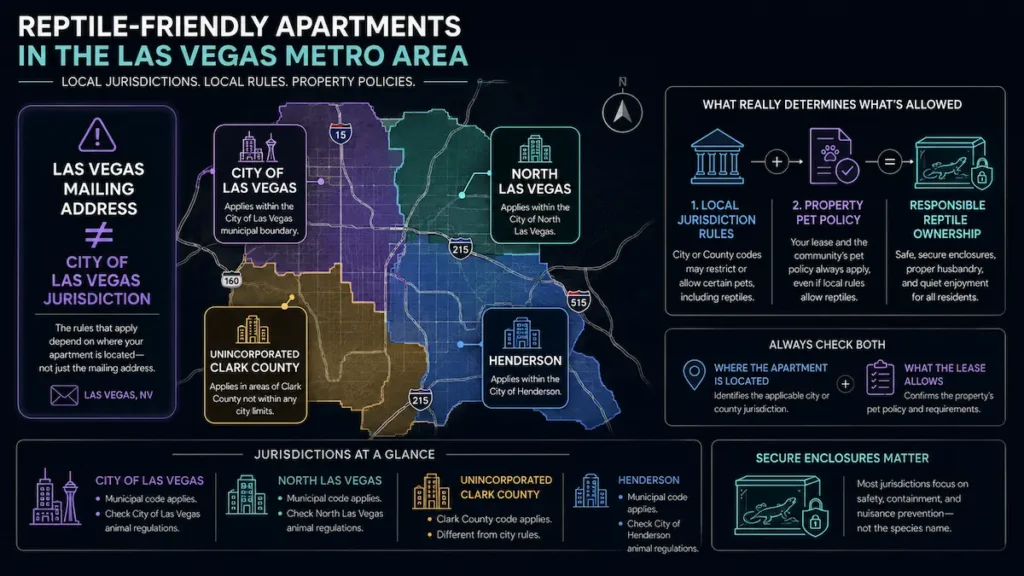
Why a “Las Vegas” Address Doesn’t Tell You Which Animal Code Applies
This is the single most important practical thing to understand before apartment hunting here, and it’s a bigger issue than in most cities we’ve covered.
A huge share of well-known “Las Vegas” addresses — including the Strip corridor, the UNLV area, and large residential neighborhoods like Silverado Ranch, Spring Valley, Enterprise, and Summerlin South — are technically in unincorporated Clark County, not the City of Las Vegas. Both properties we verify below illustrate this: Ascent at Silverado (Silverado Ranch) and Fusion Las Vegas (Paradise) carry “Las Vegas, NV” addresses but are governed by Clark County’s ordinances, not the city’s.
The practical jurisdictions you’re most likely to encounter in this metro (not an exhaustive list of every incorporated city in Clark County):
- City of Las Vegas — its own municipal code, discussed below
- Unincorporated Clark County — governed by Clark County Code Chapter 10.18, discussed below
- North Las Vegas — a separate incorporated city with its own animal-control code (North Las Vegas Municipal Code § 6.10.040 governs “wild animals,” though we could not confirm from public sources whether it addresses common non-venomous pet reptiles specifically)
- Henderson — another separate incorporated city, discussed below
Before you do anything else: look up the specific address of any property you’re considering (not just its mailing city) to determine which of these jurisdictions actually applies. A property manager or a quick call to the relevant animal-control department can confirm this in a couple of minutes. One honest limitation worth naming up front: none of the three properties we’ve reviewed so far sit physically within the City of Las Vegas itself — two are in unincorporated Clark County, one is in North Las Vegas.
That’s not an oversight; it reflects how much of the “Las Vegas” apartment market actually sits outside the city’s own boundaries. We don’t yet have a confirmed property inside the actual city limits, and closing that gap is a stated priority for our next update.
A property’s written pet policy and the local government’s animal code are two separate questions. Norterra Canyon’s published policy confirms what that property allows; it doesn’t mean North Las Vegas has independently confirmed the animal under its own municipal code. Both layers matter, and neither substitutes for the other.
| Jurisdiction | Common pet reptile status | Local issue | What renters should do |
|---|---|---|---|
| Unincorporated Clark County | All four species: nonvenomous reptiles not reaching 12 feet or more at maturity qualify as household pets under Clark County Code § 10.04.182 | Confirm your address is actually unincorporated | Confirm the address is unincorporated, then check the county code definitions |
| City of Las Vegas | Scope for common captive-bred reptiles not confirmed | LVMC Ch. 7.38’s wild-animal/permit framework and how it treats private (non-exhibited) pets | Contact Las Vegas Animal Protection Services directly |
| North Las Vegas | Not independently resolved in public sources | § 6.10.040’s “wild animal” definition and whether it extends to common pet reptiles | Contact North Las Vegas Animal Control |
| Henderson | Published guidance identifies venom- and length-based restrictions | Exact controlling Title 7 provision behind those thresholds not independently confirmed | Contact Henderson Animal Protection Services |
How We Verify a Las Vegas Property as Reptile-Friendly
We do not treat a property’s general “pet-friendly” label — or even a broader “exotic pets welcome” claim — as evidence that reptiles specifically are permitted. For this guide, “reptile-friendly” doesn’t mean a property accepts pets generally; it means we found property-controlled evidence that specifically addresses reptiles. A property is only listed here under one of these ratings:
| Rating | What it means |
|---|---|
| Confirmed — Written Policy | The property’s current published pet policy explicitly names reptiles as permitted. Strongest evidence tier — anyone can check the source. |
| Confirmed — Written Leasing Confirmation | The published policy is silent, but the leasing office has confirmed in writing (email, addendum) that reptiles are permitted. |
| Policy Conflict | Two or more current property-controlled sources make materially contradictory statements about reptile permission. |
| Prohibited | A current property-controlled source explicitly excludes reptiles, and no equally authoritative current source expressly permits them. |
| Policy Unclear | The property discusses pets or “exotics” generally but doesn’t clearly address reptiles either way. |
| Not Verified | No reliable current evidence. A generic “pet friendly” marketing page alone doesn’t qualify. |
We’d rather show you two verified properties than thirty scraped ones with no way to confirm reptiles are actually included. A property may also change its policy before our next scheduled re-check, so confirm directly before applying or signing regardless of what’s shown here.
Properties we’ve reviewed for this guide:
| Property | Jurisdiction | Status | Reptiles named? | Evidence | Last checked |
|---|---|---|---|---|---|
| Ascent at Silverado | Unincorporated Clark County | Confirmed — Written Policy | Yes | Direct pet policy | August 2026 |
| Norterra Canyon | North Las Vegas | Confirmed — Written Policy | Yes | Direct pet policy | August 2026 |
| Fusion Las Vegas | Unincorporated Clark County (Paradise) | Prohibited | No — explicitly excluded | Direct pet policy | August 2026 |
Confirmed Las Vegas-Area Reptile-Friendly Apartments
Ascent at Silverado
| Status | Confirmed — Written Policy |
| Evidence | Direct pet-policy page, missionrockresidential.com |
| Reptiles named | Yes — “Exotic Pets/Animals: Including, Reptiles (snakes, iguanas, etc.)” |
| Pet fee | $300 for one pet, $500 for two pets (non-refundable), plus a $35/month premium pet fee per pet |
| Address | 10175 Spencer St, Las Vegas, NV 89183 (Silverado Ranch) — this address is in unincorporated Clark County, not the City of Las Vegas, despite the “Las Vegas, NV” mailing address |
| Policy checked | August 2026 |
What this confirms: the published policy explicitly includes reptiles. What it does not confirm: approval of every species, enclosure size, or lease-specific conditions — those are still set individually at application.
Norterra Canyon
| Status | Confirmed — Written Policy |
| Evidence | Direct pet-policy page, norterracanyon.com |
| Reptiles named | Yes — “Exotic Pets/Animals: Including, Reptiles (snakes, iguanas, etc.)” |
| Pet fee | $350 for one pet, $500 for two pets (non-refundable), plus $30/month pet rent per pet |
| Address | 5005 Losee Road, North Las Vegas, NV 89081 — within the City of North Las Vegas, a separate incorporated city with its own animal code |
| Policy checked | August 2026 |
What this confirms: the published policy explicitly includes reptiles. What it does not confirm: how North Las Vegas’s own wild-animal code treats your specific species — worth a direct call to North Las Vegas Animal Control given the open question noted above.
A Contrasting Example — Fusion Las Vegas, Prohibited
Fusion Las Vegas (4386 Escondido St, Las Vegas, NV 89119 — in the Paradise area, also unincorporated Clark County) publishes a pet policy that states plainly: “No Reptiles Accepted.” This is a useful calibration point — a property can be genuinely pet-friendly (Fusion accepts cats and dogs under standard breed/weight terms) while still excluding reptiles specifically. Always check for the word “reptile,” not just “pet friendly” or “exotic.”
Why this matters: Fusion Las Vegas accepts conventional pets but explicitly excludes reptiles. That’s exactly why a property’s general “pet-friendly” designation isn’t evidence enough on its own — you have to check for the word “reptile” specifically.
As of August 2026, this isn’t a comprehensive list of every reptile-inclusive property in the valley, and we haven’t yet confirmed a property inside the City of Las Vegas itself. Have information about one, or direct confirmation from any local animal-control department? Reach out — it helps us close the gaps flagged in this guide.
What Nevada State Law Actually Regulates
Nevada’s default rule is that no person may import, transport, or possess live wildlife without authorization. Nevada then explicitly lists specific categories of animals — including reptiles — that may be possessed without any permit or license at all. <details> <summary><strong>For readers who want the legal detail</strong> (click to expand)</summary>
Nevada Administrative Code NAC 503.140 (“Species for which certain permits and licenses are not required”), part of the official compilation maintained by the Nevada Legislative Counsel Bureau, lists specific animals that may be possessed, transported, imported, and exported without a permit or license issued by the Department. Subsection 1(aa) of that list covers nonvenomous, nonindigenous reptile species and subspecies.
Ball pythons (native to sub-Saharan Africa), corn snakes (native to the southeastern U.S., not Nevada), bearded dragons (native to Australia), and leopard geckos (native to South Asia) are all nonvenomous and not indigenous to Nevada, so our reading is that they fall within this exemption.
It’s worth being precise about what that exemption actually does: it’s a carve-out from needing a Department-issued permit or license — it does not, on its own, authorize possession in violation of any other applicable federal law, state law, or county or city ordinance. That’s exactly why the local-jurisdiction sections below matter just as much as this one.
The restricted side of the ledger is NAC 503.110 (“Restrictions on importation, transportation and possession of certain species”), which prohibits possession of specific reptile groups without a Department-issued license limited to zoos, universities, and similar institutions.
The reptile list in NAC 503.110(1)(b) is genus/family-based: all species in the order Crocodilia (alligators, crocodiles, gharials); the genus Thelotornis (bird snakes); the boomslang (Dispholidus typus); the genus Rhabdophis (keelbacks); the family Atractaspidae (burrowing asps); the family Elapidae (coral snakes, cobras, kraits, mambas, Australian elapids, and sea snakes); the family Viperidae — pit vipers and true vipers — except species indigenous to Nevada; the family Chelydridae (snapping turtles); and the family Helodermatidae (Gila monsters and beaded lizards).
Separately, NAC 503.080 classifies certain reptiles native to Nevada as protected under the state’s wildlife-taking rules — the Gila monster, certain native lizards and snakes, the western pond turtle, and the desert tortoise, which is specially protected under Nevada and federal law. This is a different legal question from pet possession of a captive-bred, non-native species; it mainly matters if you’re dealing with a wild-caught native animal, most relevantly the desert tortoise, which has its own separate adoption/possession rules under NAC 503.093.
What this means for a typical reptile owner: our reading of NAC 503.140(1)(aa) indicates that common nonvenomous, non-native pet-trade reptiles do not require a state license to possess. This is an informational reading of the current rule, not an individual species determination by NDOW. Owners of unusual species, hybrids, or animals with uncertain origin or venom status should verify the exact animal directly with NDOW rather than relying on this guide — restricted-species categories are amended over time, and a name’s absence from a summary is not the same as an official confirmation from the agency that administers the list. </details>
| Common name | Scientific name | General pet category |
|---|---|---|
| Ball python | Python regius | Non-venomous pet snake |
| Corn snake | Pantherophis guttatus | Non-venomous pet snake |
| Bearded dragon | Pogona vitticeps | Pet lizard |
| Leopard gecko | Eublepharis macularius | Pet lizard |
For regulatory purposes, an animal’s taxonomic identity and venom status matter more than its common pet-trade name — NAC 503.110’s restricted categories operate by family and genus, not a simple list of species. The table above reflects our reading of the current rule for these four specific, commonly kept species only.
City, County, and North Las Vegas Rules to Know
Legal information last verified: August 2026.
City of Las Vegas: Verify Before Signing
The City of Las Vegas regulates wild animals under Las Vegas Municipal Code Chapter 7.38 (“Wild and Farm Animals”). LVMC § 7.38.010 states that no wild animal may be exhibited or kept anywhere within the city without a wild animal permit from the Animal Regulation Officer, and the city’s own permit-issuance language refers to a permit for “each wild animal or reptile” that meets specified conditions.
Unlike unincorporated Clark County, we have not confirmed a comparable published household-pet exemption that clearly resolves how the city’s “wild animal” definition treats common, non-venomous, captive-bred pet-trade reptiles kept privately, as opposed to exhibited. If your apartment is physically within City of Las Vegas limits — not just carrying a “Las Vegas, NV” mailing address — confirm your reptile’s status directly with Las Vegas Animal Protection Services before assuming it’s treated as an ordinary pet.
Unincorporated Clark County
Unincorporated Clark County regulates exotic and wild animals under Clark County Code Chapter 10.18, working from definitions set out in Chapter 10.04. Per the county’s own definitions, no exotic or wild animal may be transported, exhibited, or kept anywhere in the unincorporated areas of the county without an exotic or wild animal permit — but the county’s “household pet” definition includes nonvenomous reptiles and amphibians that aren’t otherwise listed as an “exotic or wild animal” or an “inherently dangerous exotic or wild animal.”
Two specific exclusions matter here. The county’s inherently-dangerous-animal list covers reptiles and amphibians whose venom can cause death in humans (cobras, boomslangs, rattlesnakes, and similar). Separately, its exotic-or-wild-animal list excludes any reptile species that normally reaches twelve feet or more in length at maturity — this is the origin of the “12-foot rule” widely cited for this county. Notably, that exclusion is framed by species and by reptiles generally, not specifically by snakes: it just happens to functionally apply to giant constrictors, since no common pet lizard approaches that size.
Based on this reading of the county’s own definitions, ball pythons, corn snakes, bearded dragons, and leopard geckos are all nonvenomous, none approach 12 feet or more at maturity, and none appear elsewhere on the county’s exotic-or-wild-animal or inherently-dangerous lists — so our reading is that all four fall within the county’s household-pet definition and therefore do not require an exotic-or-wild-animal permit under Chapter 10.18.
As always with a reading of a municipal code rather than a species-specific determination from the county itself, confirm directly if your situation involves anything unusual. This ordinance applies only to unincorporated Clark County — not within the city limits of Las Vegas, Henderson, North Las Vegas, or Boulder City.
North Las Vegas
North Las Vegas has its own animal-control code (North Las Vegas Municipal Code § 6.10.040, “Keeping or Exhibiting of Wild Animals”), which prohibits keeping a “wild animal” — defined as an animal not traditionally domesticated or kept as a household pet, with named examples including raccoons, monkeys, skunks, and big cats. We could not confirm from public sources whether this definition extends to common pet-trade reptiles. Norterra Canyon, our second confirmed property, is located in North Las Vegas, so confirming directly with North Las Vegas Animal Control is worthwhile if you’re specifically interested in that property or another one in this city.
Henderson
Henderson has its own animal-control rules, published under Henderson Municipal Code Title 7 — Animals, and administered by Henderson Animal Protection Services. Henderson’s published animal-control guidance identifies restrictions on venomous reptiles and on certain reptiles based on length, including a six-foot limit described for constrictors, along with federally protected reptiles such as the desert tortoise. Because we have not independently confirmed the precise controlling Title 7 section behind those specific thresholds, treat this as guidance rather than a substitute for direct confirmation from Henderson Animal Protection Services before signing a lease here.
Nevada Security Deposits, Pet Fees, and Pet Rent: What’s Actually Capped
This is worth knowing before you negotiate any pet-related charge, reptile or otherwise. Nevada caps the total security a landlord can collect — under NRS 118A.242, a landlord may not demand or receive security or a surety bond, including any amount held as last month’s rent, whose combined total exceeds three months’ periodic rent. The statute also generally prohibits characterizing security as “nonrefundable,” with a narrow carve-out for a reasonable cleaning charge, so if a property tries to charge you a large “nonrefundable pet deposit” that functions like a security deposit, it’s worth asking exactly how that charge is characterized in the lease.
The three-month limit applies to amounts that legally function as security under NRS 118A.242 — not simply to whatever label a lease happens to attach to a charge. A recurring pet-rent charge is ongoing rent rather than security. A refundable pet deposit held against pet-related damage is more naturally treated as security and would count toward the cap. Don’t rely on the label alone: ask the landlord to identify each charge in writing and state plainly whether it’s security, a refundable deposit, a non-refundable fee, or recurring rent.
In practice, Nevada properties (including our two confirmed listings above) tend to use one or more of three distinct charge types, and it’s worth knowing which is which before you sign:
| Charge type | What it is | Typically refundable? |
|---|---|---|
| Pet deposit | Held against pet-related damage | Often yes, unless the lease clearly and validly characterizes it otherwise |
| Pet fee | A one-time charge described by the property as a fee for keeping a pet | Often non-refundable, depending on the lease terms and applicable law |
| Pet rent | A recurring monthly charge added to base rent | No — it’s ongoing rent, not a deposit |
Both properties we’ve confirmed in this guide describe their reptile-related charges as a one-time, explicitly non-refundable pet fee plus separate monthly pet rent, rather than as a security deposit. That’s how the properties characterize the charge, not a legal conclusion about how it would ultimately be classified in a dispute. Ask for an itemized breakdown in writing regardless of how a property structures its charges, and if your total upfront security obligation looks like it exceeds three months’ rent, raise that before you move in.
A note for anyone renting a house or townhome instead of an apartment: if the property is part of a homeowners association, Nevada’s Assembly Bill 161 (2019), now codified at NRS 116.318, bars an HOA from prohibiting a unit owner from keeping at least one pet, though the HOA’s governing documents can still impose their own reasonable restrictions — including species, size, or breed conditions — beyond that one-pet baseline. Check the CC&Rs separately from your lease, since they operate independently of both your landlord’s pet policy and the jurisdiction-level rules discussed above.
And note that this statute speaks to what an HOA can require of a unit owner — for a renter, the landlord’s own lease and pet policy remain a separate, additional layer of permission.
“Pet Friendly” Doesn’t Automatically Mean Reptile-Friendly
A property’s general pet-friendly marketing — even language as specific as “exotic pets welcome” — doesn’t guarantee reptiles are included, as the Fusion Las Vegas example above shows. Ask the leasing office directly whether reptiles specifically are permitted under the written policy, and get the answer in writing if you can.
One related but separate issue: an ordinary pet reptile is legally different from a disability-related assistance or emotional support animal. Where a legally required disability accommodation applies, an assistance animal generally cannot be treated as an ordinary pet for pet fees or ordinary pet restrictions — but disability-accommodation law involves its own qualification and documentation requirements, so this isn’t an automatic blanket exemption from every property requirement. This guide covers ordinary pet ownership only.
A property-level reptile-friendly policy also doesn’t automatically guarantee approval for every species, enclosure, or lease — individual unit, occupancy, or manager-approval conditions can still apply. Always confirm at the individual-application stage.
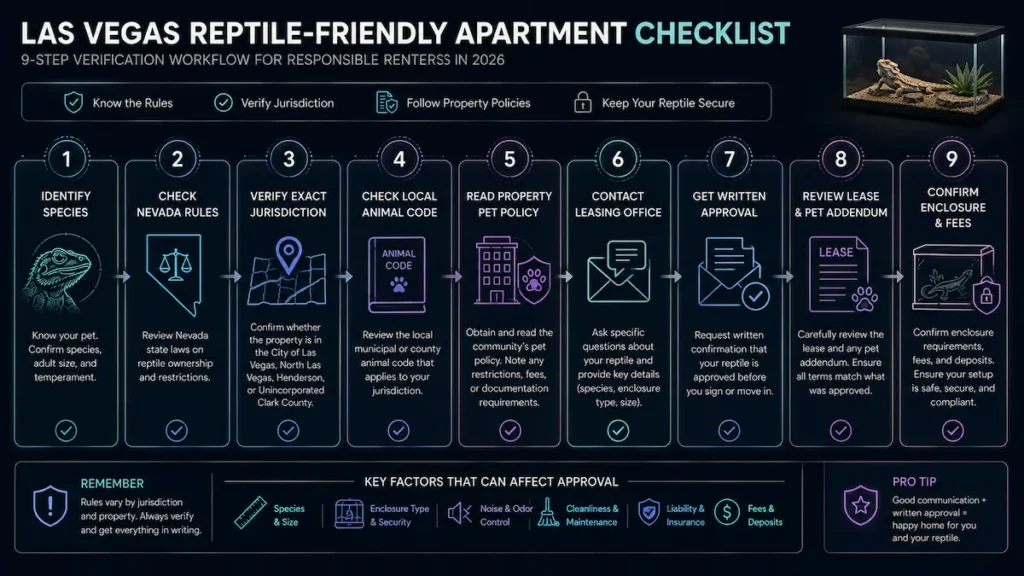
Before You Apply: The Right Order of Questions
- Identify your species precisely (common and scientific name) — regulatory treatment can hinge on the exact species and its venom status.
- Check Nevada’s state-level rules for that species (above).
- Look up the exact address of the property you’re considering and identify which jurisdiction actually governs it — City of Las Vegas, unincorporated Clark County, North Las Vegas, Henderson, or another incorporated city. Don’t assume from the mailing address alone.
- Check that jurisdiction’s local animal code — mainly relevant for venomous species and (in unincorporated Clark County) large constrictors, but worth confirming for any species given the City of Las Vegas’s less-clear scope.
- Read the specific property’s written pet policy before touring. Look for the word “reptile” specifically, not just “exotic pets” or “pet friendly.”
- If the policy doesn’t address reptiles either way, contact the leasing office directly.
- Get written confirmation — an email or lease addendum, not a verbal yes.
- Review the actual lease and pet addendum before signing, and confirm exactly how any pet-related charge is categorized against Nevada’s security-deposit cap (above).
- Document your enclosure and confirm your insurance situation before move-in.
Desert Heat: Two Practical Problems Beyond Enclosure Setup
Las Vegas’s extreme heat creates two separate practical problems for reptile keepers. Neither is solved simply by the fact that some popular pet reptiles come from warm climates — species vary widely in their native conditions, and each still needs its own controlled enclosure temperature, humidity, and lighting regardless of what’s happening outside. (Our Phoenix guide covers the same desert-climate issue in more depth if you’re weighing both cities.)
Enclosure placement and overheating. A glass enclosure in direct desert-facing window sun can overheat rapidly — a genuine animal-welfare concern independent of anything a landlord cares about. Keep enclosures away from direct window exposure.
HVAC and power reliability. The less-discussed issue: what happens if your unit’s air conditioning fails, or the building loses power, during a prolonged period of extreme summer heat. For most reptile owners the challenge isn’t heating the enclosure — it’s ambient room temperature if climate control goes down for hours. Keep a backup thermometer/hygrometer in the enclosure, have a plan for where to move the animal short-term if an outage looks extended, and know your building’s maintenance-request process for HVAC outages before you need it.
A secure, well-maintained enclosure can also address practical landlord concerns such as escape prevention and sanitation, but the property’s own rules still control. Building weight capacities for a large, fully set-up glass terrarium vary by property and floor; ask the property manager directly if you’re planning a large tank or several enclosures.
How to Ask a Las Vegas-Area Landlord About Your Reptile
Copy-and-paste message to a leasing office:
“I wanted to let you know I have a pet [ball python / bearded dragon / leopard gecko]. My reptile lives full-time in a secure, [size]-gallon enclosure that stays in one location, and the enclosure is designed specifically to prevent escape. I’m happy to provide photos of the setup and any documentation the property requires, and I’m glad to comply with the property’s pet terms, sign a pet addendum, and pay any applicable deposit or fee.”
This addresses the three things a leasing team is actually likely to be uncertain about — containment, what the setup involves, and the financial terms — without asking them to improvise an unfamiliar fee structure on the spot. Because Ascent at Silverado and Norterra Canyon already address reptiles explicitly in their published policies, prospective renters have concrete examples of the type of written language to look for when evaluating other properties.
Rental Application Checklist
- Confirmed your specific species is permitted under Nevada state rules
- Identified the exact jurisdiction (City of Las Vegas / unincorporated Clark County / North Las Vegas / Henderson / other) governing the property’s address
- Confirmed that jurisdiction’s local animal code, especially if your species is venomous or a large constrictor
- Confirmed with the leasing office that “pet friendly” or “exotic pets welcome” includes reptiles specifically
- Got reptile approval in writing, ideally as a signed lease addendum
- Confirmed how any pet-related charge is categorized (deposit vs. fee vs. rent) and whether it’s refundable
- Checked that your total upfront security obligation doesn’t exceed Nevada’s 3-month-rent cap under NRS 118A.242
- Checked the lease for species-specific exclusion language
- Checked the HOA’s CC&Rs separately, if renting a house or townhome
- Asked about enclosure-size or weight guidance, if planning a large tank
- Asked your renters-insurance provider what coverage, exclusions, and liability/property-damage provisions apply to your specific reptile and enclosure
- Photographed your enclosure setup before move-in, for your own records
- Created a backup plan for maintaining appropriate enclosure temperatures during an HVAC or power outage
Local Resources for Las Vegas-Area Reptile Owners
| Resource | Notes |
|---|---|
| Second Chance Reptiles | Las Vegas-based, foster-run reptile rescue. As of our August 2026 check, the rescue is on an intake hold and directs owners to its courtesy-listing rehoming program rather than direct surrender — confirm current capacity before reaching out |
| Reptile Rescue Las Vegas | Long-running local reptile resource. Per the organization’s own Facebook page, the rescue itself has retired after roughly 30 years of operation; the site and page remain online with occasional updates rather than active intake |
| Aloha Animal Hospital — Exotic Pet Care | Las Vegas veterinary practice with a dedicated exotic-pet-care service line; confirm current staff experience with your specific species directly |
Several other general veterinary practices in the valley also advertise exotic or reptile care — worth a direct call to confirm current staff experience with your specific species before you commit to one.
Frequently Asked Questions
Do I need a permit to own a pet snake in Las Vegas?
At the state level, no — NAC 503.140(1)(aa) exempts nonvenomous, nonindigenous reptiles from any license requirement. At the local level, it depends entirely on which jurisdiction governs your specific address: unincorporated Clark County’s own “household pet” definition covers nonvenomous reptiles that don’t reach 12 feet or more at maturity, which includes all four species this guide covers; the City of Las Vegas’s own scope is less clear and should be confirmed directly; North Las Vegas has an unresolved question about how its wild-animal definition applies to common pet reptiles, while Henderson publishes reptile restrictions by venom status and length that renters should confirm for their specific species.
Are ball pythons legal to possess in Las Vegas?
Based on our review, ball pythons fall within Nevada’s nonvenomous/nonindigenous exemption and qualify as a household pet under unincorporated Clark County’s own definition, since the species is nonvenomous and comes nowhere near 12 feet or more at maturity. As always, confirm both the exact local jurisdiction and the property’s own lease terms separately.
Are bearded dragons legal in Las Vegas?
Based on the same state-level exemption, yes — bearded dragons are nonvenomous and nonindigenous to Nevada. Local jurisdiction and lease terms still need to be checked independently, as with any species.
Which Las Vegas-area apartments actually allow reptiles?
We’ve confirmed two properties with published policies explicitly naming reptiles: Ascent at Silverado (unincorporated Clark County) and Norterra Canyon (North Las Vegas). This isn’t a comprehensive list, and notably, neither is inside the City of Las Vegas itself; we’ll add a City of Las Vegas property as soon as we can verify one.
Can apartments legally ban reptiles even if they allow dogs and cats?
Yes — a property can prohibit specific animal types in its lease or pet policy even when the animal is legal to own generally, as Fusion Las Vegas’s explicit “No Reptiles Accepted” policy shows. Legal ownership and contractual permission to keep an animal in a specific rental are two separate questions.
Can a landlord charge pet rent for a reptile in Nevada, and is there a cap?
Nevada doesn’t cap pet rent or a pet fee specifically, but it does cap amounts that legally function as security (including a refundable pet deposit) at three months’ rent under NRS 118A.242. Confirm exactly how your specific charges are categorized in the written lease rather than relying on their label.
Is a Las Vegas mailing address the same as being inside the City of Las Vegas?
No — and this is arguably the most important practical fact in this guide. Large parts of the Las Vegas Strip corridor, the UNLV area, and many well-known residential neighborhoods carry “Las Vegas, NV” addresses while sitting in unincorporated Clark County, not the city itself. Always check the exact jurisdiction for a specific address rather than assuming from the mailing city.
Should I disclose my reptile before applying, or after being approved?
Before applying, or at latest during the application. Disclosing upfront builds trust with a landlord; being discovered later — even with a completely harmless pet — damages that trust in a way that’s hard to repair.
Is Las Vegas a good area for reptile owners?
Nevada’s state framework is genuinely favorable for common non-venomous, non-native pet reptiles. The biggest complication for renters is local regulation and property policy: because “Las Vegas” spans several separate jurisdictions with different (and in places unclear) animal codes, renters need to do more jurisdiction-specific homework here than in a single-city market.
Climate, enclosure setup, and utility reliability are worth planning for too (see the heat section above). Once you’ve identified the right jurisdiction and found a property with a written reptile-inclusive policy, the underlying position is solid.
Key Takeaway
Nevada generally permits possession of common nonvenomous, nonindigenous pet reptiles without an NDOW license, but that doesn’t automatically make a reptile acceptable in a particular rental. In the Las Vegas metro, the exact address matters because the area spans multiple separate jurisdictions, and a property’s written pet policy matters just as much as local law. As of August 2026, we’ve verified two apartment communities with published policies that explicitly include reptiles, while a third explicitly excludes them. The safest path: identify your jurisdiction, verify your species against state and local rules, confirm the property’s written policy, and get approval in writing before you sign.
How We Keep This Guide Current
Apartment pet policies, city ordinances, and Nevada state rules can all change independently of each other. Our approach:
- Every property listed as Confirmed is re-checked against its current published policy on a rolling basis, targeting roughly every 90–180 days, with the verification date updated accordingly. A property may still change its policy before that scheduled check, so confirm directly before applying.
- Legal citations (NAC 503.110/503.140, NRS 118A.242, Clark County Code §§ 10.04/10.18, LVMC Chapter 7.38, Henderson Municipal Code Title 7) are re-checked against the current official text available at the time of each update.
- The open questions flagged in this guide — the City of Las Vegas’s exact reptile scope, North Las Vegas’s treatment of common pet reptiles, and the precise Title 7 provision behind Henderson’s reptile-length guidance — are priorities for direct confirmation in our next update, rather than left as permanent gaps.
Have information about a property inside the actual City of Las Vegas, or direct confirmation from any of the local animal-control departments referenced above? Reach out — it helps us close the gaps flagged in this guide.
This guide is part of the Nested Exotics city-by-city series on renting with reptiles. See also our guides to Austin, Denver, and Phoenix, and our general framework for renting with exotic pets.