

Last updated: August 2026
If you’ve ever searched ‘pet friendly apartments’ while owning a ball python, a cockatiel, or a bearded dragon, you already know the frustrating truth about renting with exotic pets: pet friendly almost never means your pet. Most listings are built around dogs and cats. The moment you mention anything else, the conversation changes — sometimes to confusion, sometimes to an outright no.
Here’s the good news: in the vast majority of cases, that “no” isn’t based on law. It’s based on unfamiliarity. Most landlords have never had a tenant with a reptile or a bird, so they default to caution — even though exotic pet ownership is far from rare. U.S. reptile-owning households grew from an estimated 4.7 million to 6.5 million between 2016 and recent surveys, a 38% increase that makes reptiles the fastest-growing pet category by percentage, according to industry analysis of survey data from the American Pet Products Association, the primary research body tracking U.S. pet ownership trends. You’re not an edge case; the rental market just hasn’t caught up yet.
Once you understand what’s actually going on — legally and practically — you can usually turn that no into a yes.
This guide walks through exactly that: what the law really says, how to talk to a landlord so they actually listen, what to expect species by species, and where to start looking depending on where you live.
In This Article
Why “Pet Friendly” Doesn’t Mean Exotic-Friendly
Rental pet policies are written for the pets landlords see most often — dogs and cats. Standard lease templates ask about breed and weight, not habitat type or enclosure security, so an exotic pet often doesn’t fit the form at all. That’s not a judgment on your pet. It’s a gap in how the paperwork was built.
Landlords who hesitate are usually worried about three things:
- Damage. They’re picturing claw marks and chewed baseboards, which mostly apply to dogs, not an animal living in a secured tank or cage.
- Liability. A fear that something could escape or bite a neighbor, even when the actual risk for most contained exotic pets is very low.
- The unknown. They simply haven’t had a tenant with a lizard before, and unfamiliar things get an automatic no by default.
Once you address these three concerns directly—which we’ll cover below—you’re usually dealing with hesitation, not a hard policy against you.
What the Law Actually Says About Exotic Pets in Rentals
Quick answer: There’s no single U.S. law banning exotic pets from rentals. Legality depends on your state, your city, and your individual lease — always check all three before signing.
This is the part where a lot of exotic pet owners assume the worst, so let’s be precise: there is no single, unified U.S. law banning exotic pets from rental housing. What exists instead is a patchwork of rules operating at different levels, and they don’t always agree with each other:
- State and local wildlife laws — some states or cities restrict ownership of specific species entirely (certain large constrictors, venomous animals, or protected wildlife), regardless of whether you rent or own. This is about the animal, not the housing.
- HOA or building-specific bylaws — separate from city law, a condo association or apartment complex can set its own restrictions in its governing documents.
- Individual lease terms — even where an animal is completely legal to own, your specific landlord can still choose to prohibit it in the lease, the same way they might prohibit smoking.
The practical upshot: your species’ legal status where you live matters more than any assumption about apartments in general. A ball python might be a total non-issue in one city and require a permit in another. Regulation also stacks in layers — a state law sets the baseline, but individual cities and counties frequently add their own, stricter rules on top. More than 1,000 U.S. municipalities have exotic pet ordinances that go beyond what their state requires, so “legal in my state” doesn’t automatically mean “legal in my city.”
To give you a sense of the range, rather than a false sense of precision:
| State | General approach |
|---|---|
| Hawaii | The most restrictive state overall — bans most exotic pets outright, including the majority of reptile species, due to strict invasive-species controls |
| California | Requires a state permit for restricted species, including all crocodilians and many reptile/amphibian species, and bans ferrets and hedgehogs statewide — administered directly by the California Department of Fish and Wildlife under Fish & Game Code §671 |
| New York City | Bans ferrets, hedgehogs, and most reptiles within city limits — note this is a city rule, distinct from New York State law |
| Nevada, Wisconsin, North Carolina | Among the least restrictive states, with comparatively few statewide exotic pet rules |
This is intentionally a short, high-level snapshot — not a full 50-state reference. The California entry is sourced directly from the California Department of Fish and Wildlife and the remaining states above are currently compiled from secondary legal-overview research by PetsNerd, Exotic Vet Finder, and World Population Review, pending the same direct-source verification. This table is intended as a general overview only. Laws and municipal ordinances change frequently and can vary even between neighboring cities — always verify current state and local regulations directly before signing a lease.
Always confirm your exact state and city rules directly with your local animal control office before signing a lease — we’re building out full state-by-state legal breakdowns with direct source links to make this easier to verify.
This section is general information, not legal advice. Animal ownership laws change and vary by jurisdiction — when in doubt, check with your local animal control office or a local attorney.
How to Talk to a Landlord When Renting with Exotic Pets

Quick answer: Reassure them your pet is contained and quiet, offer proof like enclosure photos or a vet reference, and propose a compromise like a higher deposit or signed pet addendum.
This is the single highest-leverage thing you can do, and most renters skip it. Instead of asking permission and hoping, come prepared to answer the three concerns above before they’re even raised.
- Lead with reassurance, not just a request.
Don’t just say “can I have a snake.” Say what the animal actually is like to live with: contained, quiet, odorless, no shedding on furniture, no barking. Most landlord hesitation comes from imagining something loose and unpredictable — correct that picture immediately. - Bring proof, not just promises.
A photo of your enclosure setup, a vet or breeder reference, or a short letter describing your pet’s care routine does more than any verbal reassurance. It signals you’re a responsible, experienced owner — not a first-timer figuring it out as you go. - Offer a compromise, not just a yes/no.
Landlords say no when they feel like they have no control over the risk. Offering a slightly higher pet deposit, or agreeing to a signed pet addendum specifying your exact animal and enclosure, gives them a paper trail and a sense of control — often enough to turn hesitation into approval.
Put together, a short introduction script might sound like this:
“I wanted to let you know I have a pet ball python — she lives full-time in a secure, locked enclosure, doesn’t make noise, and has no risk of damaging the unit. I’m happy to share photos of her setup, a reference from my current landlord, and sign a pet addendum or pay an additional deposit if that helps.”
That single message does the work of all three points at once: reassurance, proof, and compromise.
Species-by-Species Considerations
Different exotic pets raise different questions from landlords. Here’s what matters most when renting with exotic pets, species by species.
Reptiles (snakes, lizards, tortoises) are usually the easiest sell: silent, odorless, and fully contained in a tank. The main landlord concern is usually size (a 6-foot enclosure reads differently than a 20-gallon tank) and, occasionally, species-specific legal restrictions. (See our Austin, Denver, and Phoenix reptile rental guides for city-specific breakdowns.)
Birds, especially larger parrots, are a different conversation — the concern here is almost always noise, not damage or safety. If you own a naturally loud species, addressing sound directly (cage placement, training, quiet hours) matters more than reassurance about mess. (See our bird rental guide.)
Ferrets and small mammals sometimes get lumped into general “no pets except dogs/cats” policies without much specific thought — worth clarifying directly rather than assuming the blanket rule applies to you.
Large aquariums raise a genuinely practical concern landlords are right to ask about: weight. A large tank full of water is heavy, and older buildings may have real floor-load limits worth confirming before you commit to a specific tank size.
Rabbits and guinea pigs are legal in every state and usually raise the fewest concerns of any animal on this list — they’re quiet, contained, and rarely trigger the same hesitation as less-familiar species, though some blanket “no pets” policies still catch them by accident.
Hedgehogs and sugar gliders sit in an unusual spot: they’re commonly kept, but banned outright in a handful of states and cities (notably restricted in places like California and New York City) regardless of any landlord’s own policy. Confirm legality where you live before this conversation even comes up.
Amphibians (frogs, salamanders, newts) are close cousins to reptiles in terms of landlord concerns — fully contained, silent, low-risk — though a few states regulate specific species for ecological reasons, so the same “check locally” advice applies.
Tarantulas and other invertebrates are usually the easiest category of all to get approved: no noise, minimal enclosure footprint, and most people’s hesitation comes from a personal reaction to spiders rather than any real practical concern. A calm, matter-of-fact explanation of the enclosure setup tends to go a long way here.
Renters Insurance and Exotic Pets
Quick answer: Most standard renters insurance excludes exotic pets by default. Call your provider directly to ask about coverage or an exotic-pet rider before assuming you’re covered.
This is worth its own section because it trips up more owners than almost anything else on this list: standard renters insurance policies typically exclude exotic pets by default. Most policies are written with dog and cat liability in mind, and an unlisted species can mean no coverage at all if something goes wrong.
What this means in practice:
- Liability coverage (if your pet somehow injures someone or damages property) usually needs to be specifically added, not assumed. Ask your insurer directly whether exotic pets are covered or excluded — don’t assume based on the general policy summary.
- Property damage coverage for your own belongings (like a cracked enclosure or a damaged heat lamp) is separate from liability, and follows the same rule: check, don’t assume.
- Some insurers offer exotic-pet-specific riders or endorsements that can be added to an existing renters policy for an additional cost. Availability varies significantly by provider and by state, so this is very much a “call and ask” situation rather than something you can generalize.
The honest bottom line: don’t take a landlord’s requirement for renters insurance as automatic proof you’re covered for your pet specifically. Call your insurer, ask the direct question, and get the answer in writing if you can.
What to Prepare for Your Rental Application
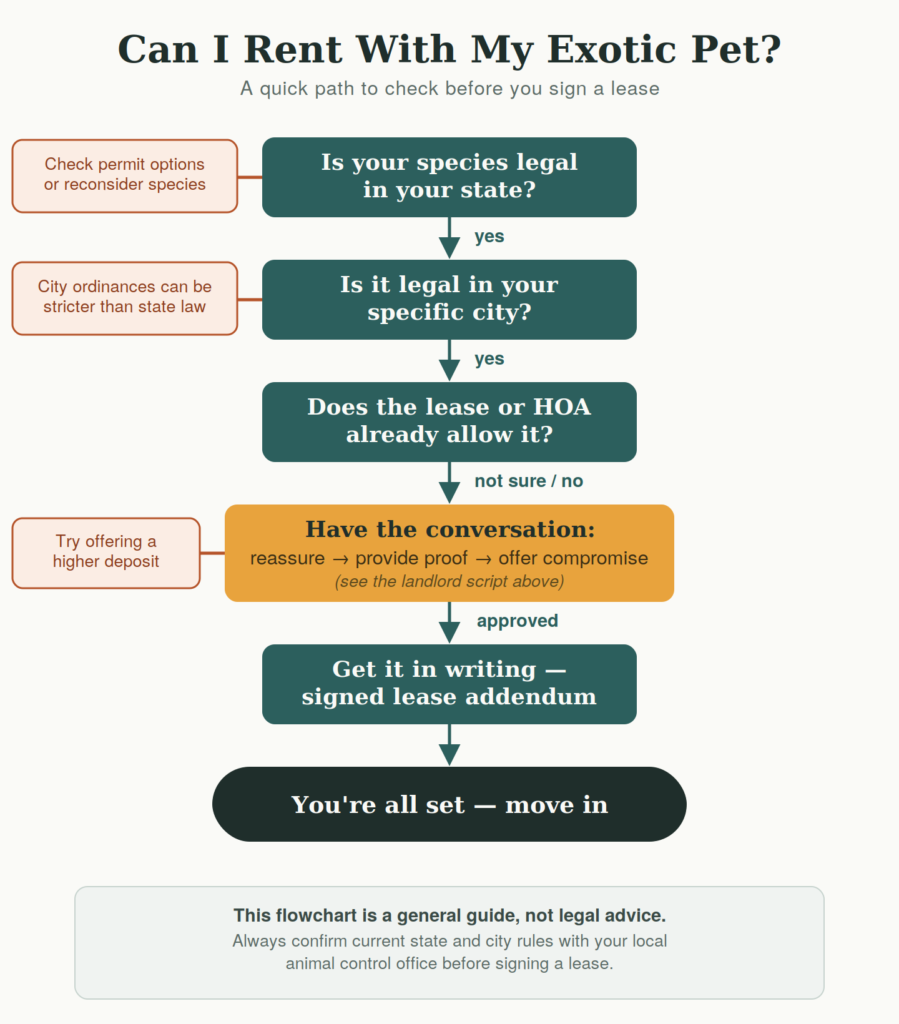
Showing up prepared does more to move a landlord from hesitant to comfortable than almost anything else. Before you view a unit or submit an application, put together:
- Photos of your pet’s enclosure — a clean, secure, well-maintained setup reassures a landlord faster than any verbal description
- A vet reference or recent health record, if you have one — signals an established, responsible ownership history
- A reference from a previous landlord, specifically mentioning the pet if possible — nothing reassures a new landlord like confirmation from a past one that nothing went wrong
- Copies of any required permits, if your state or city requires one for your species — having this ready before it’s asked for signals you’ve done your homework
- A one-paragraph written summary of your pet’s care routine, temperament, and containment — this is the same content as the landlord script above, just ready in writing so you’re not composing it on the spot
None of this is required everywhere, but having it ready costs you nothing and removes the landlord’s single biggest source of hesitation: not knowing what they’re agreeing to.
Want this as a checklist you can actually check off? Download the free Exotic Pet Rental Application Checklist (PDF) — same items above, print-ready.
What Landlords Are Actually Worried About (And What Isn’t a Real Risk)
It helps to know which landlord concerns are grounded in something real, and which are just unfamiliarity:
- “What if it escapes?” — a legitimate question for any animal, but a secured, appropriately-sized enclosure directly answers it. This is worth addressing proactively rather than waiting to be asked.
- “What if it damages the unit?” — for most contained exotic pets, this risk is genuinely lower than for a typical dog or cat, since there’s no chewing, scratching, or accidents on carpet involved. Worth pointing out directly, since it’s not always obvious to someone who’s never owned one.
- “What if my other tenants complain?” — a fair concern for loud birds, less relevant for reptiles, fish, or small contained mammals. Tailor your reassurance to what’s actually true for your specific pet.
- “What if I get in trouble for allowing it?” — this is often the real, unspoken worry, especially for landlords managing units on behalf of an HOA or property management company. A signed pet addendum protects them as much as it protects you, which is exactly why offering one tends to work.
Common Mistakes Renters Make
A few patterns show up again and again among people renting with exotic pets, worth avoiding:
- Not disclosing the pet upfront. Getting caught after move-in, even with a completely harmless pet, damages trust in a way that’s hard to undo — and can be legal grounds for eviction depending on the lease.
- Assuming “pet friendly” automatically includes exotics. Always confirm directly rather than assuming a general pet policy covers your specific animal.
- Skipping the paperwork. A verbal yes from a landlord isn’t the same as a documented one. Get any pet approval in writing, ideally as a lease addendum.
- Not checking city-level rules in addition to state rules. As covered above, a species can be perfectly legal at the state level and still restricted locally.
Where to Start Looking, City by City
Apartment complexes don’t advertise exotic-pet policies the way they advertise “dog friendly” — the information exists, but usually only if you ask directly or dig into individual property pages. We’re building out dedicated guides for major rental markets to save you that research:
We’re building out dedicated guides for major rental markets to save you that research. Published so far:
- Reptile-friendly apartments in Austin, TX
- Reptile-friendly apartments in Denver, CO
- Reptile-friendly apartments in Phoenix, AZ
Still in progress: Chicago and Los Angeles reptile guides, bird-friendly apartment guides, and state-by-state legal quick-reference guides.
Moving Day: A Quick Checklist
Once you’ve found the right place, moving an exotic pet takes a bit more planning than packing a crate for a dog:
- Temperature control matters most. Reptiles especially are sensitive to cold during transport — plan for climate-controlled transit, not just a car trunk.
- Minimize total transit time. A direct move beats multiple stops; stress from prolonged handling adds up.
- Keep documentation with you, not in a moving box. Vet records, ownership paperwork, and any permits should travel with you personally in case a new landlord or building manager asks on move-in day.
- Set up the enclosure first, before anything else. Get your pet into a stable, familiar environment before you start unpacking the rest of the apartment.
Key Takeaways
- Most rejections when renting with exotic pets come from unfamiliarity, not an actual legal prohibition.
- Check both state and city-level rules before applying; a species can be legal at one level and restricted at the other.
- Show up prepared with photos, references, and documentation rather than just asking and hoping.
- Get any approval in writing, ideally as a signed lease addendum — a verbal yes isn’t the same as a documented one.
- Confirm your renters insurance actually covers your specific pet; don’t assume it does by default.
Frequently Asked Questions
Can a landlord legally say no to my snake?
In most cases, yes — a landlord can set their own no-exotic-pets policy in the lease, even if your specific animal is completely legal to own where you live. Legality and lease terms are two separate things.
Do I need pet insurance for an exotic pet?
Usually your existing renters insurance won’t cover an exotic pet automatically — see the Renters Insurance and Exotic Pets section above for what to actually ask your provider.
What’s a reasonable pet deposit for a reptile?
There’s no universal standard, but many landlords set exotic-pet deposits comparable to what they’d charge for a small dog, even though the actual risk profile is usually lower. This is a negotiable point, not a fixed rule.
Will having an exotic pet hurt my rental application?
Not inherently — what affects your application when renting with exotic pets is whether you disclose it upfront and address it professionally, versus a landlord finding out later and losing trust. Transparency from the start works in your favor.
Have a specific species or city question this guide didn’t cover? Reach out — reader questions directly shape which city and species guides we prioritize next.
6 thoughts on “Renting with Exotic Pets: The Complete Guide”