
By Nested Exotics Team | Last updated: September 2026
Before you search for an apartment, confirm your reptile is legal to keep in New York City at all. If you’re looking for Reptile-Friendly Apartments in NYC, start with the species rather than the property: NYC Health Code §161.01 prohibits several entire reptile families — including Pythonidae, Boidae, Iguanidae, Teiidae, and Varanidae — so no landlord or board can make possession of a listed species lawful.
Generic “pet friendly” roundups often don’t address reptiles, while articles about prohibited animals don’t usually address apartment-hunting. Several also blur New York state law with New York City law, even though NYC has its own Health Code restrictions that must be checked separately. This guide fills that gap, building on our complete guide to renting with exotic pets. Comparing cities? See our Austin, Denver, Phoenix, Las Vegas, Chicago, and Los Angeles guides.
Regulatory review box Regulatory review: September 2026 · Coverage: New York City, all five boroughs · Primary authorities checked: NYC Health Code Art. 161, NYC Administrative Code §27-2009.1, NYCHA pet policy, New York General Obligations Law §7-108, FDA 21 CFR §1240.62, MTA Rules of Conduct §1050.9(h) · Next review: when any of the above is amended.
This guide covers NYC’s five boroughs, not the rest of New York State, which has its own, generally less restrictive framework — verify separately outside NYC. It focuses on commonly kept, captive-bred reptiles; several very common pet-trade species aren’t legal to keep anywhere in the city, regardless of a landlord’s policy.
This guide is informational, not legal advice. Verify your specific species and building policy directly before relying on anything here.
In This Article: Quick Answer · The Four Layers · How We Verify · Decision Path · State vs. City Law · Health Code §161.01: What’s Prohibited · Species Lookup Table · Borough Differences · The Three-Month Rule and Its Limits · Co-op vs. Condo vs. Rental vs. NYCHA · Deposits & Fees · Apartment Practicals · How to Ask · Checklist · Local Resources · FAQ
Quick Answer
Some Reptile-Friendly Apartments in NYC may allow reptiles, but the city adds a layer most other cities in this series don’t: a health code that lists an unusually long set of reptile families as prohibited outright, regardless of what any landlord or board allows. Confirm your species’ status under that code first — a separate question from whether a specific property’s pet policy covers it.
We don’t publish unverified “reptile-friendly” listings. A building only counts as Confirmed once we have current written confirmation from the property or board.
In This Article
The Four Layers That Actually Govern Your Reptile in NYC
| Layer | The question | Who controls it | Primary source |
|---|---|---|---|
| 1. Law | Can I legally possess this reptile in NYC at all? | NYC Dept. of Health and Mental Hygiene | Health Code §161.01 |
| 2. Building rules | Does my building’s type or policy allow it? | Co-op/condo board, landlord, or NYCHA | Proprietary lease, house rules, or NYCHA pet policy |
| 3. Lease/board approval | Do I have written permission for my unit? | The property/landlord/board | Written pet policy or addendum |
| 4. Practical suitability | Can I safely maintain the enclosure here? | You | Building heat, electrical capacity, space |
Layer 1 is non-negotiable and citywide. Layers 2–4 vary building to building. A “yes” at Layer 2 is worthless if the species fails Layer 1 — that ordering, not landlord goodwill, is what actually decides whether you can keep your reptile in NYC.
How We Verify Reptile-Friendly Apartments in NYC
Last verified: September 2026 — this describes our research approach, not a directory of confirmed buildings.
We haven’t called individual NYC leasing offices or boards to build a verified property list, so we won’t present one here. What primary-source research does show: NYC’s rules are unusually layered, so getting the order right — species status, then building type, then written policy — matters before you tour a single apartment.
Level 1 — Confirmed: signed lease/addendum · written property or board policy permitting reptiles · written leasing-office confirmation Level 2 — Policy Unclear: “pets allowed” language that doesn’t mention reptiles Level 3 — Not Verified: generic “pet friendly” listing label · a broker’s verbal assurance · forum comments
Have direct experience with a specific NYC building or board and reptiles? Reach out through our main guide — reader input shapes our next verified directory entries.
Quick Decision Path
- Identify your species precisely (family-level matters here — see below).
- Check it against Health Code §161.01(b)(10). If it falls within a prohibited category, a landlord’s or board’s permission does not make possession lawful under the Health Code — this is a legal-status question, not a building-policy one.
- Confirm your building type: co-op, condo (which borough), rental, or NYCHA — this determines whether tolerance can ever create a legal waiver.
- Read the property’s or board’s actual written pet policy.
- Contact the leasing office or managing agent if it doesn’t address reptiles.
- Get written confirmation — not a verbal yes.
- Review the lease or addendum before signing.
- Document your enclosure and confirm insurance before move-in.
What New York State Law Regulates
Outside NYC, most common pet reptiles — corn snakes, leopard geckos, crested geckos, bearded dragons — fall outside New York State’s restricted-wildlife framework, which targets large carnivores, primates, and a narrower band of genuinely dangerous reptiles. That’s more permissive than the city’s own rules, which is exactly why the city code needs separate scrutiny. Verify county/municipal rules separately outside NYC with the NYS DEC. General information, not legal advice.
NYC Health Code §161.01: What’s Actually Prohibited Citywide
Verified against the current DOHMH-published text of Health Code Article 161, §161.01(b)(10).
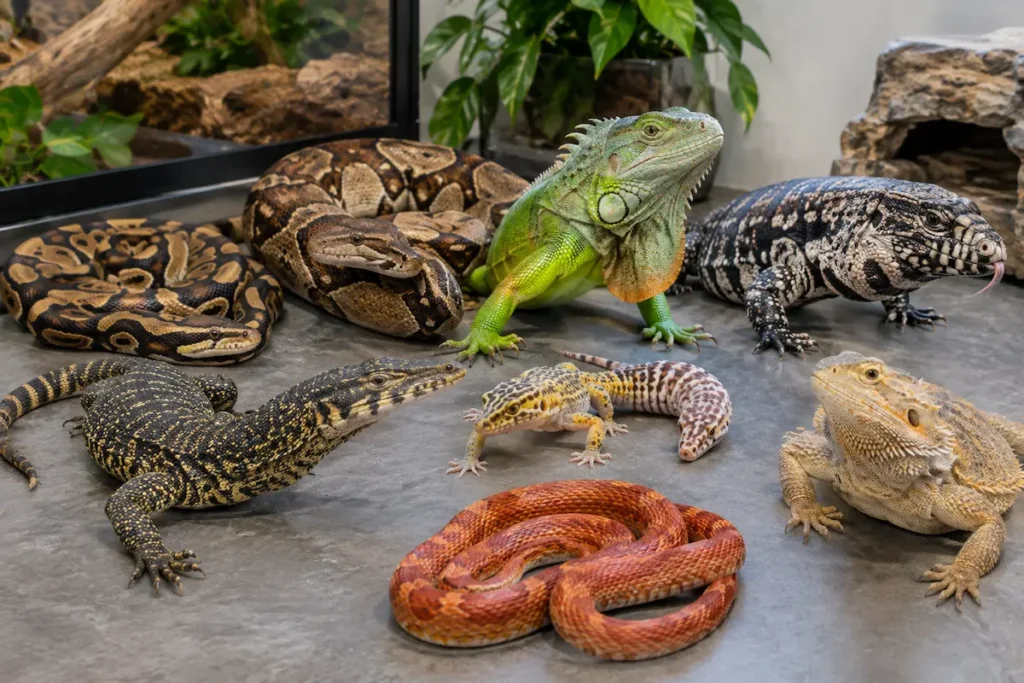
The Health Code lists as prohibited, by family: all Helodermatidae (gila monsters); all front-fanged venomous snakes, even devenomized; all venomous mid/rear-fanged Duvernoy-glanded Colubridae; any member of family Boidae (including anacondas); any member of family Pythonidae; any member of family Varanidae (monitor lizards); any member of family Iguanidae, including the green iguana; any member of family Teiidae (tegus); all Chelydridae (snapping turtles); all turtles/tortoises under a 4-inch carapace; and all Crocodylia.
Three points surprise most renters:
- The python and boa families are prohibited entirely — including the ball python and the common boa constrictor, the two most popular beginner pet snakes in the US.
- Iguanas, tegus, and all monitors are prohibited by family, not by size.
- The 4-inch turtle rule mirrors FDA regulation 21 CFR §1240.62, in place nationally since 1975 — not a uniquely punitive city rule.
Health Code §161.02 defines a “small animal” as a companion animal — including a reptile — “whose possession is not prohibited by §161.01.” That’s the operative legal category a permitted pet reptile falls into. This is our reading of the current published code, not legal advice; confirm any unclear species directly with DOHMH.
Common Reptiles: NYC Legal Status at a Glance
| Reptile | Health Code §161.01(b)(10) status | Apartment policy note |
|---|---|---|
| Ball python | Prohibited (family Pythonidae) | Cannot be authorized by any landlord or board |
| Boa constrictor | Prohibited (family Boidae) | Cannot be authorized by any landlord or board |
| Green iguana | Prohibited (family Iguanidae) | Cannot be authorized by any landlord or board |
| Tegu | Prohibited (family Teiidae) | Cannot be authorized by any landlord or board |
| Monitor lizard (any species) | Prohibited (family Varanidae) | Cannot be authorized by any landlord or board |
| Gila monster | Prohibited (family Helodermatidae) | Cannot be authorized by any landlord or board |
| Snapping turtle | Prohibited (family Chelydridae) | Cannot be authorized by any landlord or board |
| Corn snake | Not prohibited | Building/board approval required |
| Kingsnake, milk snake | Not prohibited | Building/board approval required |
| Leopard gecko | Not prohibited | Building/board approval required |
| Crested gecko | Not prohibited | Building/board approval required |
| Bearded dragon (Agamidae) | Not prohibited | Building/board approval required |
| Turtle/tortoise, 4″+ carapace | Not prohibited | Building/board approval required |
“Not prohibited” means the Health Code doesn’t list the species — it does not mean any building must permit it. That distinction is the article’s central point; treat every “not prohibited” row as subject to Layer 2–4 above, not as a standalone green light.
Does Your Borough Affect the Three-Month Rule?
Health Code §161.01 applies citywide with no borough exceptions. Borough differences arise mainly from how New York courts have treated the Three-Month Rule for condominium owners:
| Borough | What changes |
|---|---|
| Manhattan | Condos: case law has not extended Three-Month Rule protection here; no-pets policy generally enforceable anytime |
| Bronx | Condos: case law has not extended Three-Month Rule protection here; no-pets policy generally enforceable anytime |
| Brooklyn | Condos: covered by the Three-Month Rule, same as co-ops |
| Queens | Condos: covered by the Three-Month Rule, same as co-ops |
| Staten Island | Condos: covered by the Three-Month Rule, same as co-ops |
The Three-Month Rule applies to co-ops in all five boroughs, subject to its statutory requirements. This borough split isn’t written into §27-2009.1 itself — it reflects differing appellate treatment of condominiums, so confirm your specific building’s status with counsel rather than relying on geography alone.
The Three-Month Rule — and Why It Won’t Save a Prohibited Reptile
Admin Code §27-2009.1 (the “Pet Law” or Three-Month Rule) waives an otherwise enforceable no-pets lease provision if a tenant in a multiple dwelling keeps a pet openly, with the landlord’s knowledge, for three months without an eviction proceeding — see Seward Park Housing Corp. v. Cohen, 287 A.D.2d 157 (1st Dep’t 2001), discussed in the NYC Bar Association’s legislative analysis of the statute. Later amendments also address replacement and additional pets, and the statute contains its own species-specific and nuisance conditions.
Because how those protections apply can depend on the species, building type, and specific circumstances, don’t treat the Three-Month Rule as automatic permission for a future reptile — verify your situation directly rather than assuming the waiver carries forward.
The detail most NYC content misses: the statute only waives lease clauses for pets “the harboring of which is not prohibited by the multiple dwelling law, the housing maintenance or the health codes of the city of New York.” It waives a lease clause — it cannot waive a Health Code prohibition. A tenant cannot use the Three-Month Rule to make a Health Code-prohibited animal lawful to harbor, even if building staff knew about it. This rule protects a tolerated leopard gecko or corn snake; it is not a workaround for the species list above. NYCHA is expressly exempt from the statute.
Borough/building-type scope (see table above) is documented in industry legal coverage of the statute, including a co-op/condo board legal analysis in Habitat Magazine. Confirm your specific building’s coverage with counsel if a dispute is actually at stake. General information, not legal advice.
Co-op vs. Condo vs. Rental vs. NYCHA
- Co-ops (all boroughs): Board sets pet policy by proprietary lease/house rules; can decline non-prohibited reptiles at its discretion. The Three-Month Rule applies here, subject to its statutory requirements.
- Condos, Brooklyn/Queens/Staten Island: Bylaws govern, but also covered by the Three-Month Rule.
- Condos, Manhattan/Bronx: Bylaws govern only — case law has not extended Three-Month Rule protection here.
- Private rentals (3+ units): Lease governs; covered by the Three-Month Rule.
- NYCHA: NYCHA’s own pet policy lists reptiles among prohibited pets outright and is expressly exempt from §27-2009.1.
A “pet friendly” listing does not necessarily specify whether reptiles are permitted. Ask directly, and get the answer in writing — especially in a co-op, where an informal “no” from one board member isn’t a documented policy. A pet reptile is legally distinct from a service or emotional-support animal, covered by separate disability-accommodation law not addressed here.
Deposits, Fees, and Security Deposit Law
No NYC property publishes a standardized reptile fee. Under New York’s Housing Stability and Tenant Protection Act, General Obligations Law §7-108 caps most residential security deposits and advances at one month’s rent total. If a pet-related payment is legally treated as part of that deposit or advance, it falls under the same cap; a separate, non-refundable pet fee or added monthly pet rent may be treated differently depending on how the charge is structured. Confirm the legal basis of any pet-related charge directly with the landlord rather than assuming it is either automatically capped or automatically exempt.
Apartment-Specific Practicals
- Steam heat: older buildings’ radiator cycling can complicate stable enclosure temps — plan UTH/thermostat setup around your building’s pattern.
- Old electrical circuits: check capacity before running multiple heat lamps and humidifiers on one circuit.
- Space: factor enclosure footprint into your unit search early.
- Transit: MTA Rules of Conduct §1050.9(h) require animals other than service animals to be carried in an enclosed container on subways and buses — plan vet-visit transport accordingly.
- Escape prevention and sanitation are practical concerns for landlords and boards — a secure, well-maintained enclosure helps address both.
How to Ask an NYC Landlord or Board
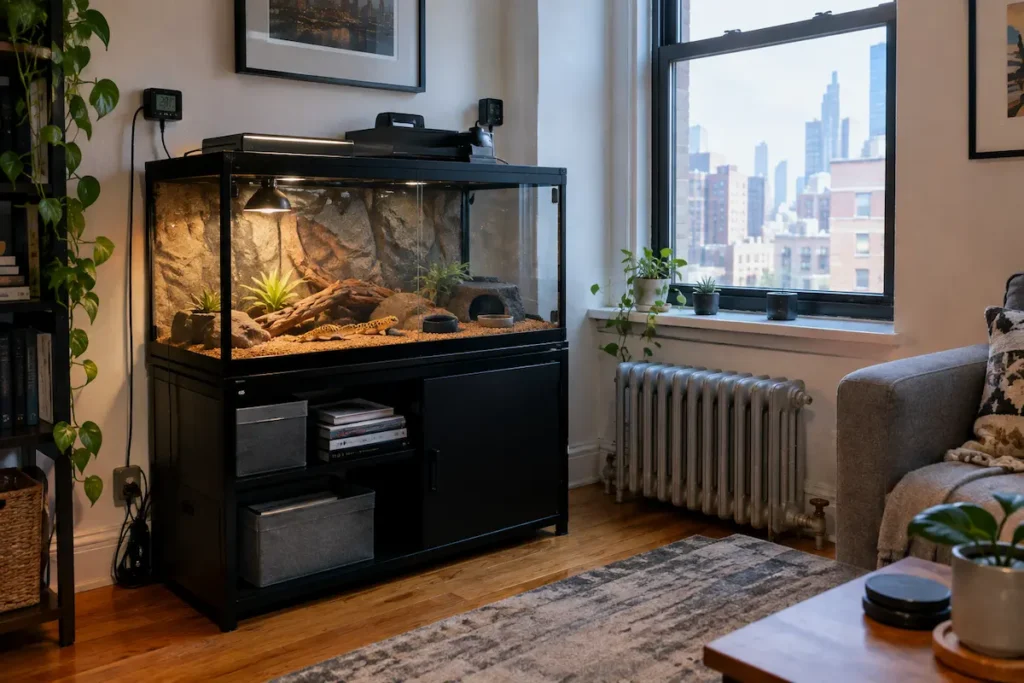
“I have a pet [bearded dragon/leopard gecko/corn snake], a species confirmed not prohibited under the NYC Health Code. It lives full-time in a secure, [size]-gallon enclosure designed to prevent escape. I’m happy to share photos, sign a pet addendum, and pay any applicable fee — and I’d appreciate written approval for both our records.”
Leading with the species’ legal status resolves the first objection an unfamiliar landlord or board is likely to raise.

Reptile Rental Application Checklist
- Confirmed species isn’t on the §161.01(b)(10) list
- Confirmed building type (co-op/condo+borough/rental/NYCHA)
- Confirmed “pet friendly” includes reptiles, in writing
- Got written approval (addendum or board letter)
- Confirmed the Three-Month Rule actually applies to your building, if relying on it
- Confirmed how any pet charge is classified against the state deposit cap
- Confirmed renters insurance covers your reptile
- Planned enclosure around building heating/electrical
- Photographed setup before move-in
Local Resources
- The Center for Avian and Exotic Medicine (Manhattan) — dedicated reptile and amphibian veterinary care.
- Schwarzman Animal Medical Center (AMC) — board-certified reptile/zoo-medicine specialists and exotic emergency care.
- Regional herpetological societies (New York Herpetological Society, Staten Island Herpetological Society, New York Turtle & Tortoise Society) — contact directly for current meeting schedules.
FAQ
Are ball pythons prohibited in NYC?
Yes — family Pythonidae is listed as prohibited in its entirety under §161.01(b)(10).
Are boa constrictors prohibited in NYC?
Yes — family Boidae is also listed as prohibited.
Are bearded dragons prohibited in NYC?
No — not listed in §161.01(b)(10); building policy still governs.
Can the Three-Month Rule protect a reptile my landlord never objected to?
Possibly, if the reptile is lawful to harbor and the statute’s conditions are met. It cannot override a Health Code prohibition, doesn’t apply to NYCHA, and its treatment of condo owners varies by borough. If you’re relying on it in an actual dispute, get legal advice.
Does the Three-Month Rule apply to Manhattan condos?
Case law has not extended it to Manhattan and Bronx condos the way it applies to co-ops and to Brooklyn/Queens/Staten Island condos — see the borough table above.
Finding Reptile-Friendly Apartments in NYC takes more than checking a “pet friendly” label. Confirm that your species is lawful under the NYC Health Code, identify your building type, review the property’s written policy, and get approval in writing before you sign.
Part of our complete guide to renting with exotic pets.